The first 18 years of one’s life may be the most critical time in a person’s development. Everyone knows that the family has a profound influence on character development and the formation of values. I am sure that that influence molded me in ways that even I do not understand, but I do accept.
Probably less recognized is the effect that the environment outside my family had on me. In order to understand my motivation and understanding of the world after those years after age 18, I have to think about the town in which I was raised and the people with whom I interacted.
Streets with No Names
I guess growing up I knew where Walker Street and Main Street were, but outside of those two streets I cannot recall knowing other street names. We knew streets by landmarks, usually where people lived. Lower Braidwood, the East side, the Pinnick’s and the Faletti’s, the Round house, Rossi’s the spaghetti factory, and Buddy Perona’s. No numbers were connected with any streets.
The towns surrounding Braidwood must have had a similar street system. Robac’s tavern in Godley, Coal City flanked by Carbon Hill, Eileen, and Diamond; Wilmington’s paper mill, mysterious Essex, and the far reaches of Morris, Elwood, Symerton, South Wilmington. No town had more than 2,000 people, mostly with landmarks not identified by street names.
The Strip Mines
Braidwood emerged as a population center in the late 1800’s with the discovery of coal. A boom town that boasted of shaft mines and bars, it was the new home for immigrants from Europe as well as for 2ndand 3rdgeneration Americans. At one time, it was estimated that the population hovered around 5,000.
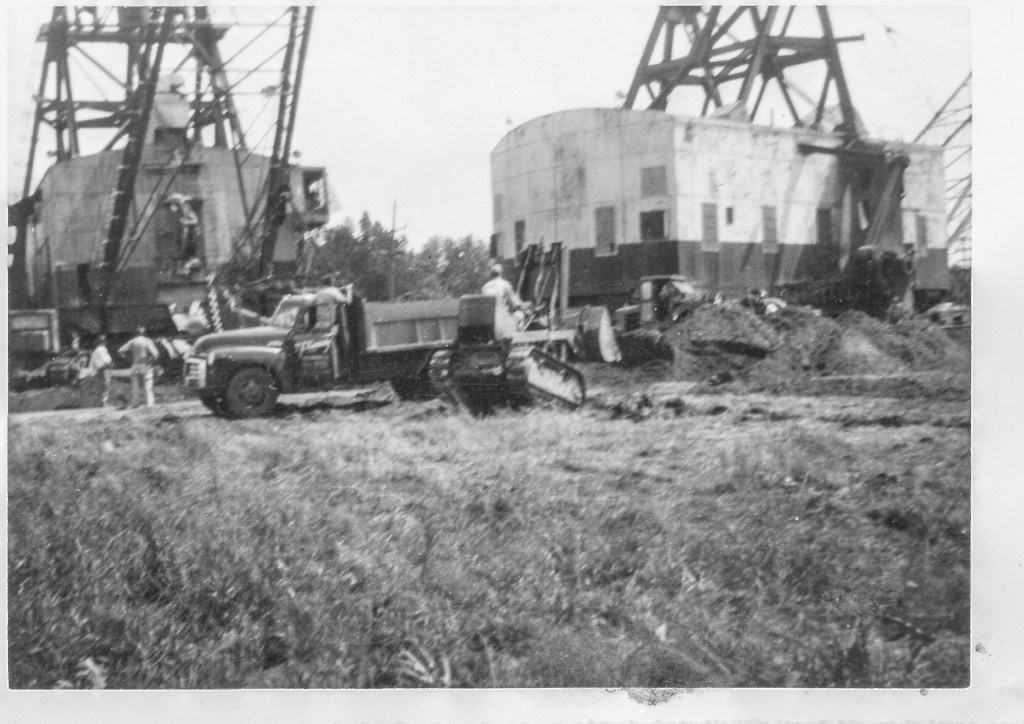
By the time that I was born in 1940, shaft mines had been replaced by strip mines that employed fewer people but huge equipment that would “strip” the top layers of earth (60-80 feet) in order to reach the coal veins. A result of the stripping, huge holes were dug out and piles of the dirt hills were deposited alongside the openings. This dirt, called “spoils,” were brown and gray, clay, rocks and everything else subterranean. Until I was a teenager, these hills had sparse vegetation. Over the years, however, trees and bushes grew as nature took over.
Soon after the holes were dug, spring water filled the pits, where the coal had been extracted. Lakes were created in the former farmer fields. Some pits were quite deep.
Virtual Playground
But for a young boy in the late 1940’s and early 1950’s, the strip mines were a virtual playground. New vegetation on the hills provided us with adventure while the lakes were great for ice skating and swimming. Summers were especially a wonderful time, out of school on vacation and too young to hold a job other than paper delivery. Colin Kelly, Billy and Roger Novy, along with my sister would spend most of the day tramping up and down the hills, building things and pretending we were scouts in an earlier century.
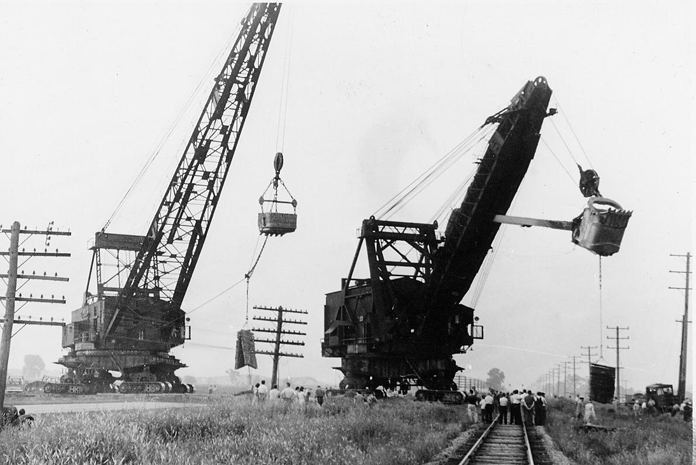
A particular attraction was the huge dragline cranes that dug the pits to the level of the coal. Mammoth is the only word for these electrically driven machines that would rhythmically swing back and forth, scooping huge amounts of dirt, then depositing it on the other side of the pit.
Sometimes, when the coal vein had run its course at one location, the drag line had to be moved. Very slowly. They moved via “walkers” like pistons that played leap frog. They were planted on the ground as the machine was lifted and moved forward, then lifted and set down again a few feet further. The whole process was repeated until the machine had been moved to a new location.

 Braidwood Beginnings