“The faculty at Lewis and St. Francis were on board with the merger that we kiddingly referred to as Frannie-Lewie U.”
Dr. Joe “Tippy” McFadden, Lewis Dean and Faculty Member
Between 1967 and 1971, Lewis College and the College of St. Francis laid plans that would have merged the two Catholic institutions into one university that would potentially become the third largest Catholic university in Illinois. Only De Paul University and Loyola University would be larger. It would be known as Lewis-St. Francis of Illinois.
Let’s imagine how that would look today if the merger had blossomed instead of being terminated in 1971.
According to Wikipedia, “Lewis-St. Francis of Illinois” now enrolls a student population of nearly 15,000 making it the 3rd largest Catholic university in Illinois. Affectionally known as “Frannie-Lewi U”, the University has an overarching Board of Directors but maintains two Catholic traditions: Franciscan and Lasallian.
Located on two campuses in Will County, the University offers more than 80 undergraduate programs, 30 graduate programs, accelerated programs for adults for working adults, and 6 doctoral programs. Modified academic programs are also offered at two out-of-state satellite campuses in New Mexico and Arizona.
The collaborative benefits and advantages far outweigh any former rivalries. Business and registrar functions are coordinated, and faculty collaboration assure that students from both campuses are well served.
It all made sense to merge the two small Catholic colleges.
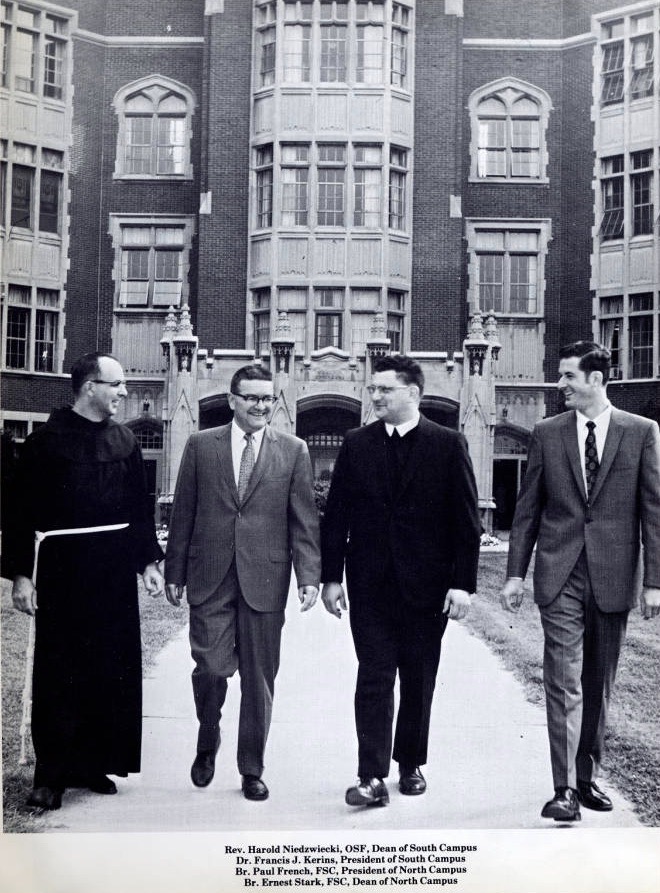
In the beginning, it made complete sense that Lewis and St. Francis were likely candidates for joining forces. Since the Christian Brothers had assumed their leadership at Lewis in 1960, the College was remade into an all-male institution. Previously, Lewis had been constituted as a “diocesan” Catholic college located in Lockport, Illinois serving men and women. The College of St. Francis, located 6 miles to the south in Joliet, served women students.
Since both colleges were relatively small, academic departments sometimes had limited resources and numbers of faculty members. Athletic facilities were modest at Lewis and nearly non-existent at St. Francis. Importantly, their education missions were nearly identical. Their respective Catholic religious orders were distinct but not incompatible. From an outsider’s view, a match between the two colleges were like fitting two pieces together in a puzzle of competition and market challenges in higher education.
Starting quietly with academic departmental collaboration, students from both colleges took integrated courses on either the “North” campus or the “South” campus. Regularly scheduled buses provided transportation and grades were seamlessly transcripted in registrar offices. Specialty courses at both institutions enriched student academic experiences.
My job at Lewis started in 1967 and coincided with the beginning steps to a merger. I became the first soccer coach, assistant baseball coach, and a co-director of intramural athletics. In addition, the Lewis athletic department began providing intramural sports to the St. Francis women. Student directors from both campuses supervised the separate leagues.
What went wrong?
There were several theories as to why the merge ultimately failed. Was it a power struggle between the two boards? Did jealousies exist between the two Catholic religious orders? Were the two religious’ traditions in conflict? Were there elements of male-female sexism? Could they not agree on a president? Or did each institution determine that they could do better on their own?
I pondered over these questions for many years and even asked people who were intimately involved in the proposed merger. My sources included: Fr. David Clarke, Bob Kaffer, and Joe McFadden. Fr. Clarke, the former president of Regis University, was hired as the academic provost over the two institutions. Both Bob Kaffer and Joe McFadden were deans at Lewis. Each provided insights and opinions.
I don’t pretend to know the answer. From my perspective the merger was working well, and the students were reaping the benefits of this collaboration. It would be easy for either side to blame the other. One of the student benefits can be seen in the fact that many St. Francis and Lewis students decided to merge on their own, successfully producing marriages and blended “Frannie-Lewis U” families.



 Braidwood Beginnings