“Paving People Paths” is a term that can be interpreted both literally and figuratively. It represents my early truck driving days hauling materials for paving roads and highways. Providing transportation pathways in our country. “Paving paths” can also mean to assist and guide people to successfully determine their own best roads to the future through education.
My passion for innovation in terms of education delivery and athletic activity for all had been sparked. After five years of teaching and coaching, my path was being re-charted to athletic coaching and sports administration. That path quickly led to genius Coach Gordie Gillespie and Lewis College where there was fertile ground for innovative coaching and intramural programming.
Lewis College
Certainly, there was more than a little remorse leaving the Roncalli High School scene, both in terms of the classroom teaching and coaching. I hoped that my students felt a little more secure in their paths to the future, but I was deeply concerned about so many of them whose next location would be Viet Nam. Fortunately, I was able to be with many of them again at several class reunions.
Having altered my route from teaching and coaching high school students to the college scene meant a significant change in personal time allocation. My arrival on the Lewis College campus in September of 1967 emphasized coaching over classroom teaching, the opposite of the previous five years. Over the summer, I planned on developing the Flyers’ first soccer team, evaluating and assessing a successful intramural program for likely initiatives, assisting Coach Gillespie on varsity baseball, coaching the JV baseball team, and preparing P.E. classes.
The commuting distance from my Joliet home to Lewis was reduced significantly but I was now in a situation where practices and intramural events would require evening hours, weekends, and travel. Fortunately, my workday might begin in late morning. That would be my pattern for the next five years and during that time our family added two more children. As usual, Dolores oversaw and maintained the essence of our family while I juggled job and father roles. Only in later times would I fully appreciate her dedication, sacrifice, and unfathomable support. Remarkable. How lucky was I!
If my first 18 years of living in Braidwood had created me, it was Lewis College that shaped me. It was at Lewis where I found my voice and enabled an offbeat talent for creating excitement for students. I found that I had a knack for initiating and implementing new, different, and effective programs or schemes regardless of my inexperience. Had it not been for the latitude and tolerance of Gordie Gillespie, nothing noteworthy could have been accomplished.
In baseball, Gordie was always looking for new ways to conduct practices and game strategies. We experimented with new drills and even gimmicks. His ability to motivate, identify talent, and anticipate opposing coaches’ moves were outstanding, but his openness to change was equally remarkable. Every year, he became a better coach.
As much as Gordie loved coaching, he also valued and promoted sports for all students regardless of their athletic abilities. In fact, he directed intramural athletics at Joliet Catholic at various times. But his support for Lewis Intramural sports enabled Paul Ruddy and me to grow the program that would ultimately capture the interest of the entire college.
Intramural Sports
Paul was flexible and open to my suggestions on how we might improve and expand a very good intramural program. When I proposed a weekly newsletter for better communication among participants, Paul jumped on the idea. Thus, we gave birth to “The Competitor.” Capitalizing on intergroup rivalries, “The Competitor” created such characters as the Purple Poet and the Prognosticator’s Premonitions. The Prognosticator employed colorful verbs to predict scores.
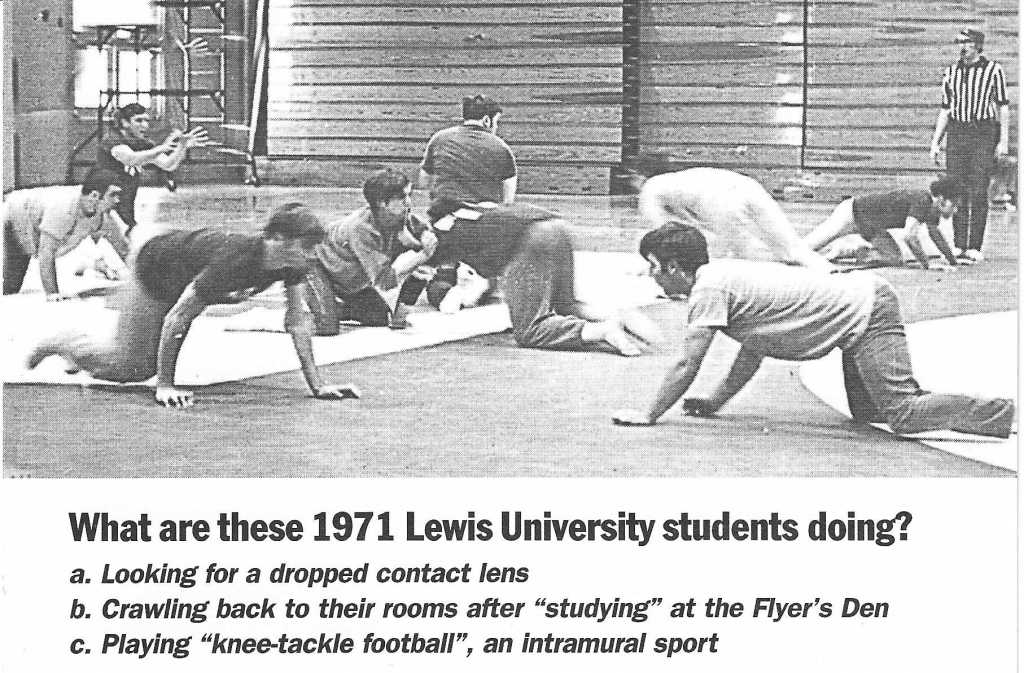
Other intramural events made for extreme interest. Knee tackle football, striped basketballs, 3-point shots, and women’s volleyball/basketball with St. Francis were successful attempts to enliven student participation that was estimated to involve 90% of the resident students. The remarkable thing about intercollegiate and intramural athletics is that both contributed significantly to the Christian Brother mission to educate young adults while classroom learning zeroed in on individual learning and isolation.
Team sports required group collaboration and cooperation in order to achieve a tangible goal. In the process, bonding and long-lasting relationships superseded and surpassed graduation dates. Even after half a century, groups that emerged in intramurals continue to function as high-quality extended families.
Intramural events was also the stage for the contemporary social malady: racism. Healthy competition could quickly devolve into spontaneous or premeditated verbal or physical outbursts. Contact sports had to be monitored closely and game officials, themselves students, took on roles that strained peer relationships. Unintentional fouls could churn latent revenge acts that might be perpetrated hours or even days later. But, for the most part, cooler heads and reasonable students (black and white) maintained their mutual respect.
While Intramural Sports captivated me and my student-athletes, it was in my baseball coaching responsibilities that I gained amazing insights into the world of the greatest coach/teacher in America, Gordie Gillespie. For a five-year period, my life was absorbed in adding another dimension of the previously mythical magic of being coached to being the coach’s apprentice, colleague, and friend.
Next Blog: Coaching with the Greatest Coach
We cannot hold a torch to light another’s path without brightening our own.
Ben Sweetlan

 Braidwood Beginnings