
“From its inception in 1981, the Regis University accelerated adult education learning program gradually gained national and international recognition among its peer institutions as a model to be emulated. At the time, there were only five other colleges that employed the same model. By 2010, this model had been adopted by hundreds of colleges and universities.”
When I arrived at Regis in 1986, I was only vaguely aware of an extraordinary adult education program called RECEP. My initial focus was on the campus where I was living and learning about the Jesuits mission, the students, staff, and faculty.
I admit that I was intrigued by the concept of accelerated classes, off-campus locations, and part-time faculty. It had an innovative higher education philosophy with quality control measures, and was recognized by its faculty, students, and employers as a top-notch education opportunity.
It seemed somewhat similar from the model at St. Francis but…it had reduced class contact hours. How did they do that? I needed to learn more.
Entering Year Two at Regis
The frenzied first year of my job officially ended in August 1987 and I could recalibrate my focus on pursuing new opportunities for Regis. I no longer had the “Acting” title when the new V.P. of Student Affairs arrived on campus.
President Clarke had returned from his 6-month sabbatical and my new colleagues in administration had graciously accepted me into their team. Besides the president, Bob Kaffer, Bill Husson, and Allan Service supported the guy from Illinois as could reasonably be hoped for. These people were friendly and encouraging but they, like myself, weren’t sure exactly what I might be doing next at Regis.
Over the next two years, our partnerships with Coors, AT&T, and StorageTek performed well with directors at each location. They were generating positive publicity and were financially productive on a small-scale level. But the question remained: How could our small institution provide something unique to outside organizations? What did the College have to offer?
Thinking Adult Education
I knew from first-hand experience that the College of St. Francis had a unique approach for its adult degree completion program. The program consisted of an “upside-down” degree format. CSF provided the liberal arts curriculum that colleges called their “core courses.” Students entered the program with their academic major in nursing already intact and then could complete the general education requirement with the College. That meant that they would graduate with a St. Francis Bachelor of Health Arts Degree.
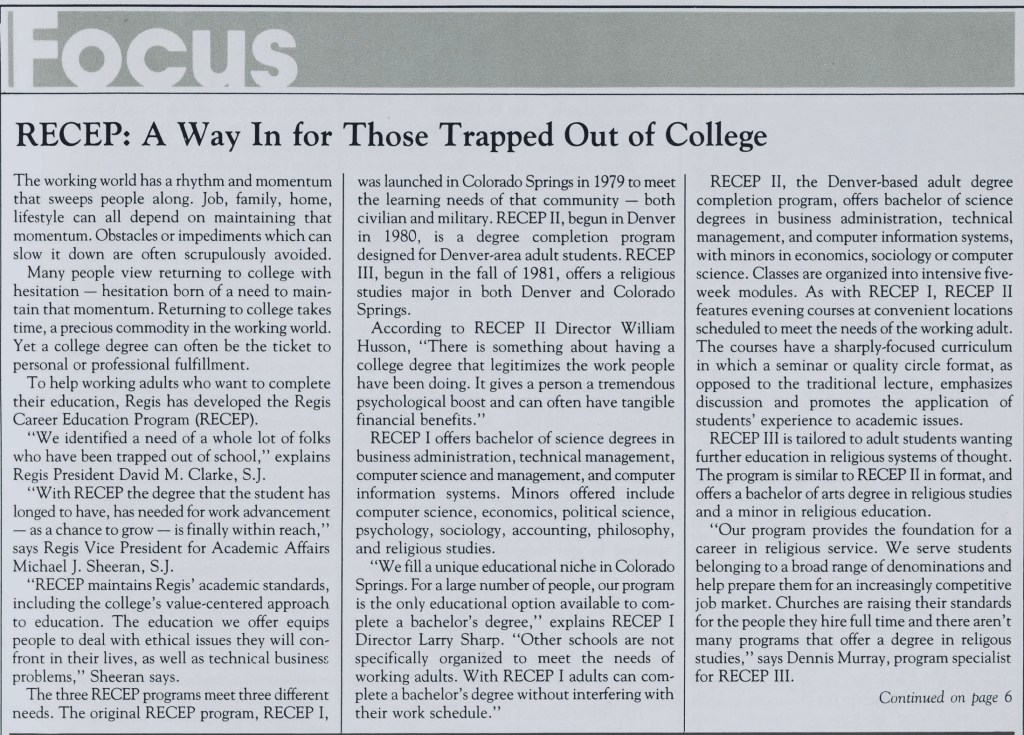
The Regis adult education program (RECEP or Regis Career Education Program) was a typical business degree except for the fact that it was “accelerated.” That meant that class time was condensed and met one time per week for 5 or 8 weeks. The program had other critical features such as: requiring students to have prior work and college experience; intense screening and development of faculty; extensive student customer services; and common curriculum modules.
Both programs, incidentally, were started by Fr. Clarke, first when served at St. Francis and then at Regis. And…they proved to be financially sound to the extent that they supported not only themselves, but they supplemented those inadequately funded, but necessary, traditional academic programs.
(At the time that I had arrived on campus in 1986, RECEP headcount of adult learners was about 3,500, more than double the number of traditional aged students on the campus. By 2012, the adult programs through the College for Professional Studies would have about 15,000 students and generated revenue of $61M and $37 in direct expenses. Keep in mind that the University annual operating budget was about $119M.)
Accelerated Education: A Value to Other Colleges?
What made the Regis program unique, beside the comprehensive quality assurances, was the significantly reduced classroom contact time. A 3-credit hour course would meet once per week for 4 hours. Twenty contact hours instead of 40, with considerable outside class time dedicated to the course.
Now that it was established that Regis had something uniquely suited to a different student population, the question on the table was: 1) take RECEP across the country as St. Francis had done; or 2) assist other colleges to adopt and adapt the model as their own. (a modified “franchise” approach.)
For a variety of reasons, we decided on the “franchising” or “leveraging” approach. Would other small, private colleges might be interested in the RECEP model? If so, how would we transport it?
Personal and Institutional Missions Congruence
The two most important dates in anyone’s life are: the date you are born and the date you figure out why. For me, the “why” revolved around my family first and then my purpose in work. I had concluded that education and learning somehow would figure in my work world. Teaching and coaching initiated me into that realm after college. After years being part of secondary and post-secondary education, I saw that adult education was my passion and a particular field that fit my mission.
The big question that had to be addressed was the role of Regis in this enterprise. It was critical that it had to fit within the mission of developing leaders in the service of others. My interpretation of “leaders” – in addition to students – was that other private colleges with similar missions could come under the umbrella of leaders in the service of others.
An additional mission factor related to the Jesuit belief in the “common good.” Although there will always be some competition among private colleges and universities, the idea of sharing a resource would help other colleges that were struggling to stay solvent by extending their mission to an underserved adult population.
The Regis mission and purpose accommodated and embraced this new venture.
What Next?
My task now was clear: to identify a partner school that would be interested in using the RECEP model of adult education. At the time, only a few colleges in the country were using the model which indicated that there could be hundreds of candidates, but one stood out. My alma mater, Lewis University, seemed a likely college for a pilot project.

 Braidwood Beginnings
One thought on “Aligning Personal Mission with Institutional Mission = Fulfillment”