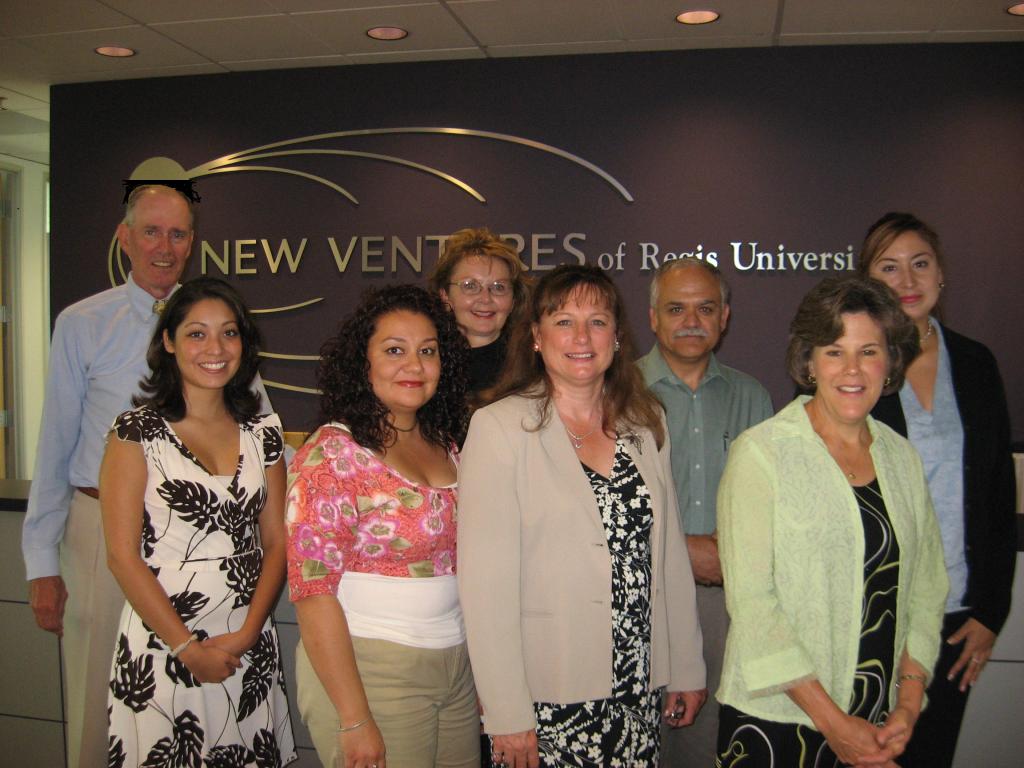
Taking a new job in Denver in 1986, I was unclear as to the specific projects that would be ahead of me. It wasn’t clear to the Regis College president either, but he seemed to have enough confidence to hire and support me. Four years later in 1990, we launched the first new project for the College and met with unqualified success: helping other colleges across the nation to develop and implement accelerated adult education programs. We called them “Partner Schools.”
By the year 2000, it was apparent that accelerated programs were becoming more common place in private higher education. If New Ventures were to continue to play a meaningful role and survive at Regis, new initiatives had to be developed. Since partnering with over 30 colleges and universities had emerged as a core competency for our team, the challenge was how to apply that expertise in a new way.
Partner School Support
While engaged with Regis, the partner schools were contributing needed educational programming and financial contributions for their institutions. Sustaining these programs, however, met with continual resistance and interference from their internal sources. New Ventures provided a support system that could be called on during stressful intramural conflicts. It’s an old story that continues to beleaguer most colleges.
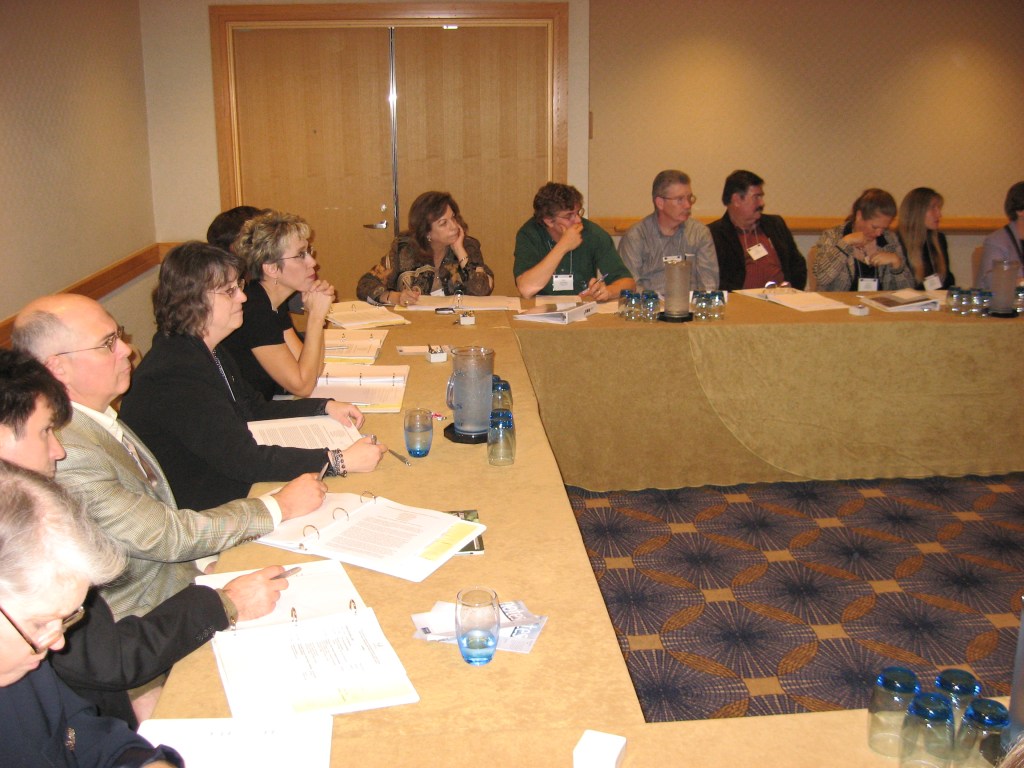
Each partner school had discovered that support was available not only with New Ventures but also among their peer partner schools. The strength of these relationships was evident during the New Ventures annual conferences. Such “user groups” seem to congeal with a strength that takes on a life of its own.
Might there be a strategy to establish a joint effort that could enable an alliance of like-minded colleges?
Distance Learning
In the meantime, a newer delivery model had crashed upon the higher education scene: distance learning. Regis University, through the School for Professional Studies, became a pioneer in distance learning via videotaped lectures beginning in 1993. It was one of a handful colleges to provide full degrees online through the internet.
The New Ventures partner schools, until now, were limited to classroom-based delivery but were requesting assistance for online courses and programs. Unable to invest the financial resources required to put their courses online and support such activities, they sought New Ventures help.
A Regis colleague, Joe May, had implemented an academic consortium in his previous job with the Colorado Community Colleges. Could that model serve as a prototype for a potential New Ventures online consortium that would assist the partner schools? We had much to learn.

Planning for an academic online consortium involved a multitude of key people from Regis. Bill Husson, Alan Service, and New Ventures staff members met with various partner school representatives over a two-year period and developed a strategic plan that was implemented in January 2005.
(See the publication from IGI Global, “Build an Online Program Consortium” by Kennedy and Brozovich for the article that Mary and I wrote in 2009. https://www.igiglobal.com/chapter/build-online-program-consortium/11757)
OCICU is Launched in 2005
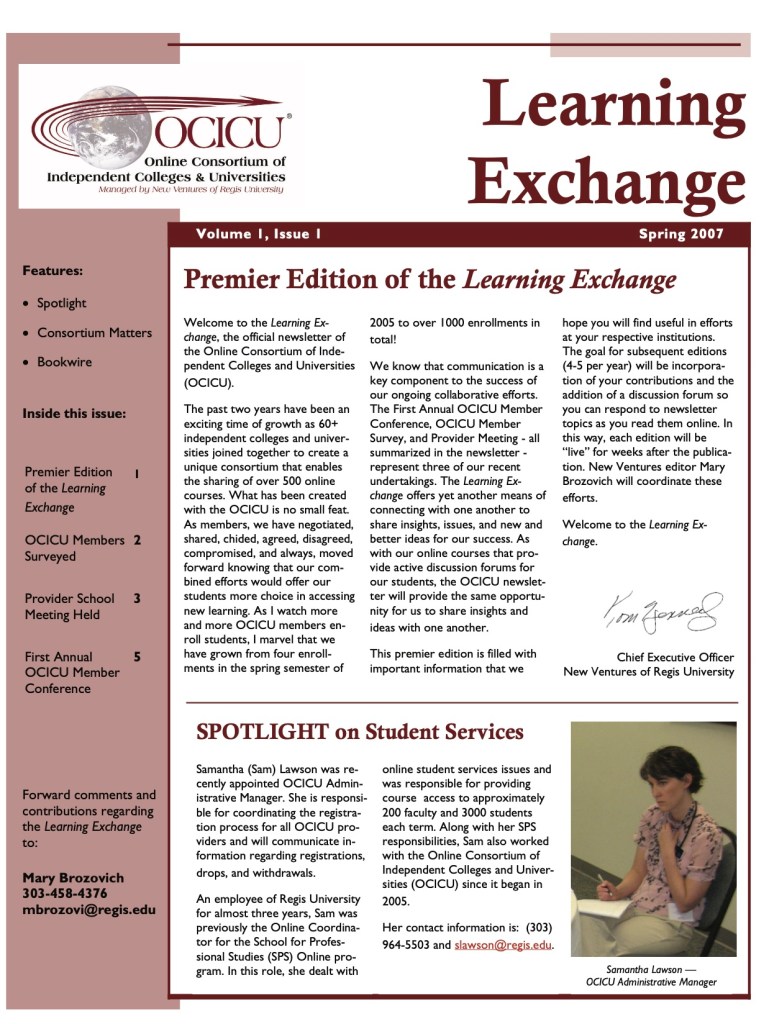
Between the inception of the New Ventures “Online Consortium of Independent Colleges and Universities” (OCICU) in 2005 through 2013, over 90 member colleges and universities were able to provide additional educational opportunities for the students through OCICU. In addition to serving national institutions, the consortium enabled an Irish Studies program to be offered by the National University of Ireland Galway to Consortium member school students.
Notably, Gallaudet University in Washington DC became a member in 2009. Gallaudet, a federally chartered university, was established for the education of the deaf and hard of hearing in 1864. Its charter was signed by President Lincoln.
Between 1995 and 2005, there were two additional New Venture significant initiatives that took place: Ateneo de Manila University in the Philippines and the Ana G Mendez University System in Puerto Rico. Both projects deserve blog posts of their own in the near future.
Shortly after I left Regis in 2014, New Ventures would continue to operate under a new name, “Higher Learning Partners,” and OCICU now operates as “The Course Exchange.” The former OCICU currently has about 60 members and has recently signed a formal relationship with the University of Tennessee Online and the Association of Jesuit Colleges and Universities (AJCU). https://www.courseexchange.org
In Retrospect
When I walked onto the campus in 1986, I had no concept of where the next 20 years would take me and Regis. By 2006, the unit called “New Ventures” would drive me and my teammates down a path of educational ventures that would extend the Regis name far and wide. More importantly, it would forge the rich Regis educational resources into partnership alliances that provided new learning opportunities for thousands of people. And perhaps strengthen the financial viability of several struggling private colleges.
Developing partnerships, alliances, and joint ventures supported the University mission and worked toward extending the “common good.” It also confirmed the principle that teamwork was required in order to do anything worthwhile and enduring.



 Braidwood Beginnings