Fear: an unpleasant emotion caused by the belief that someone or something is dangerous, likely to cause pain, or a threat.
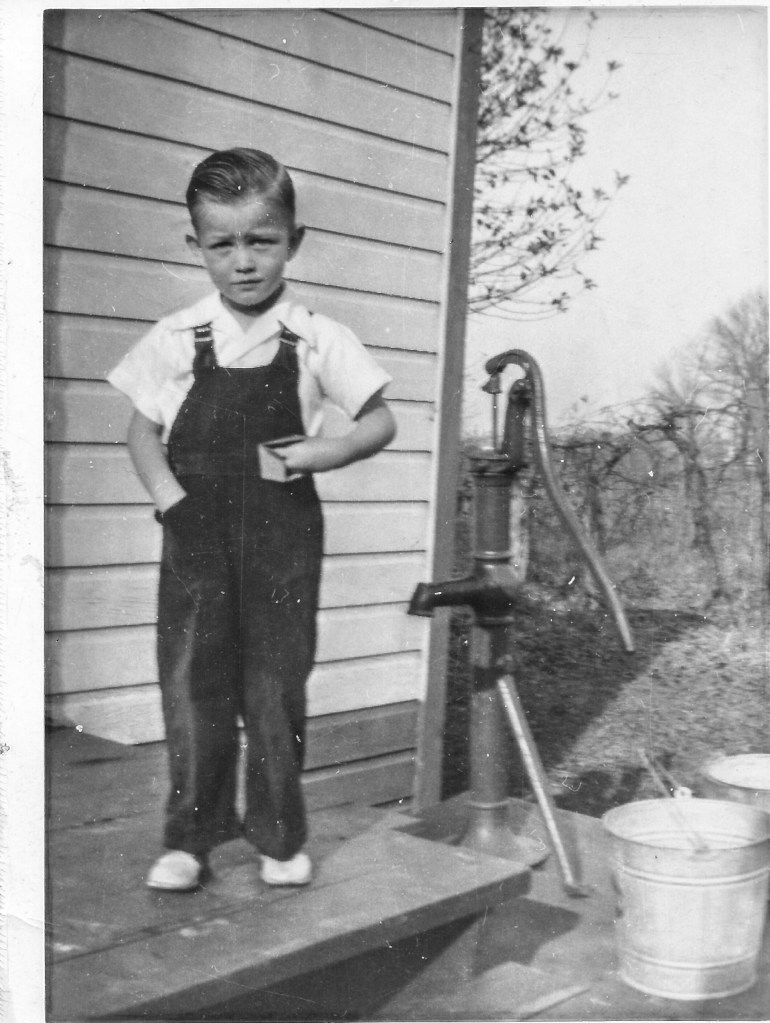
Growing up in Braidwood, I had all the unfounded fears of childhood and then some. Why? Braidwood was a safe town of 1,200. Low crime rate, friendly neighbors, extended family of Kennedys, Ginters, and Klovers within a few miles in Wilmington and Elwood. You would think that my childhood would be free from the anxieties that my siblings and I experienced.
What Did I Fear? (a Few)
“Mother’s gonna make all your nightmares come true.
Mother’s gonna put all her fears into you.” (Pink Floyd)
Violent Storms
Violent storms have a history in the Midwest. Severe thunderstorms accompanied by lightning strikes scared Mom who in turn frightened me, my sister, and brother. We would huddle together, burn some palms, and count the seconds between lightning flashes and sounds of thunder. One second counted equaled one mile away. We relaxed as the seconds increased between the two.
We were in the direct path of a tornado on Walker Street when I was about 10 years old. Mom got the message on the phone that a tornado had touched down a few miles west of us and was headed directly toward our location. We jumped in the car and drove south only to be confronted by a neighbor, Mrs. Poppleton, who also needed a ride out of town. (Party telephone lines spread the word quickly.)
Contagious Diseases
Mom was especially concerned about contagious diseases. Polio was the number one threat until a vaccine was developed and people were inoculated. In the 1950s, our swimming activities ceased after the month of July because August would always see an increase in the number of cases.
Of course, Mom had other health concerns: head lice and public toilets. Accordingly, we were careful where we sat at the Mar Theater and avoided all public toilets whenever possible.
“Mama’s gonna keep baby healthy and clean.
You’ll always be baby to me.”
Nuclear Weapons
Shortly after the atomic bombs were dropped in Japan, other countries began to develop their own version of the bomb. Naturally, our family was especially fearful of a Russian atomic bomb being dropped on the Joliet Arsenal. Our drills at St. Rose Grade School included hiding under our desks as if that exercise would protect us.
“Mother do you think they’ll drop the bomb?”
Girls
It wasn’t that my female classmates or the girls in Braidwood ever posed a threat to me. Rather, I was quite shy and didn’t date until I was about 17 years old. Neither Mom nor Dad ever actively discouraged me from socializing, and I had many girl friends that joined me on the fan bus to basketball games or at home games. The bus to Joliet Catholic and St. Francis was mixed and friendly. But Mom had somehow sent the message that no Braidwood or Wilmington girl would ever be good enough.
“Mother do you think she’s good enough — to me?
Mother do you think she’s dangerous — to me?
Mother will she tear your little boy apart?
Mother will she break my heart?”
Self-inflicted Fears
The normal anxieties of childhood, pre-teen, and teen years made their way into my head. They included being embarrassed, made fun of, nightmares, and being targeted by bullies. Though they were considered part of growing up, these fears caused some trauma to me and my peers.
The Source of My Fears
Fortunately, age, maturity, and knowledge overrode these unfounded fears and defused those real and imagined terrors that were completely out of my control. But that is not to say that there aren’t memory fragments that linger sporadically in late night dreams.
As with most parents, mine tended to be overly protective due to their own history of stress and misfortune. My mother had already seen her first child badly injured by a car when he was 22 months old. It would have been natural for her to incorrectly assume that she and Dad had acted irresponsibly.
Both had been raised in tough family situations. Mom had six sisters (Helen, June, Alice, Kate, Bess, and Mary) and one brother, George. She married at a young age, lived through the Great Depression, and saw the country enter World War II.
At ten years of age Dad witnessed his mother’s death in childbirth on the farm near Symerton. He worked on farms throughout the Midwest to send money home and labored on the pipeline in Oklahoma during the Depression.
How could my parents avoid passing on their concerns, worries, and fears onto their kids?
What I Did Not Fear
Unlike my young African American friends, I didn’t fear police or walking in the wrong neighborhood. Or ringing the wrong doorbell. Dad didn’t give me “the talk” to warn me about being in the wrong place at the wrong time. But I did learn how differently they and I were treated by some white people when I was with one of my Black friends.
Guns didn’t scare me because Dad and I had hunted together and he taught me about caution and safety with a lethal weapon. Of course, I am talking about hunting pheasants, ducks, or geese with a shotgun. (I am still confused by people needing to carry handguns for protection. Their fear is shared by millions of people today. I refuse to share in that fear.)
Until high school, I didn’t fear eternal damnation. My family were Sunday church attendees but would not be considered as zealous Catholics. The high school Carmelite religion teachers and retreat masters were somewhat convincing missionaries for a time, but their long-term effect on me proved negligable.
Fear as Our Enemy
I am concerned that fear is the dominant force in our country and is tearing us apart, driven by a sense that disease and danger lurk around every alley of society. Some of it is real, most of it is fiction. Social media and cable news effectively fuel a bunker mentality that paints dark pictures of everything, luring us into the comfort and false security of tribes, while dividing us from one another. It might be better to burn palms and count the seconds between headlines and alarms.
“If you want to control someone, all you have to do is to make them feel afraid.”
Paulo Coelho

 Braidwood Beginnings