It isn’t very often that one has the opportunity to talk with a deceased ancestor. The circumstances have to be near perfect. My chance to visit with one of my 16 great, great grandparents did happen on a morning a few weeks ago between sleep and waking up. Some folks would call this a dream, but to me it was self-induced reality.
I had previously invested many weeks reading genealogy notes and letters from deceased relatives who had compiled historical data about the Kennedy ancestors. That data complemented my own research via the National Archives and the internet. I was swimming in information, but the stories behind the data were missing until I met remotely with great, great Granny Mary Walsh one early dawn.
The following is my conversation with Mary Walsh, the first of my ancestors to arrive in America in 1836. Although my time is July 2022, Mary’s time is January of 1836 prior to her departure to America.
The Conversation
Tom: “Mary, sorry to boldly insert myself into your dreamtime but I need to ask you a few questions. You are an essential part of my life although you cannot possibly recognize it at this time. You have decided to leave your family and your native Ireland In a few months for a strange land, across a huge body of water. Surely, your thoughts and fears have weighed heavily upon you for some time. Why did you make this decision?”
Mary: “O sweet Jesus! Must I think of this again? My dreams are now rising to the nightmare stage by talking to a voice so real. Why did I make this decision? There are many reasons, but I’ll mention a few.
As a middle child with two older and three younger siblings, I have always been more adventurous, and unsatisfied with my surroundings. Waterford is all that I have ever known and I see what happens to women my age. No future except to care for babies, fight through sicknesses like cholera, and witness religious battles. My mother has endured many hardships and I don’t want to repeat her story.”
Tom: “Aren’t you fearful of the journey as a single woman?”
Mary: “In Ireland as a 27-year-old woman, I’m called a “Spinster.” What is my future here? If I don’t go now, when will I leave? I am more fearful to stay in Ireland.”
Tom: “What will the trip be like, Mary? Where do you go from here?”
Mary: “I know that I must buy a ticket at a shop here in Waterford. It will cost me about 8 pounds, money that I have already saved. I may have to travel to Liverpool, England for the trip to America. That trip might take up to 80 days, but it will be worth it, please, God.”
Tom: “Why America, Mary? Other ships leave Ireland with destinations to Australia and Canada.”
Mary: “I have a cousin and women friends in New York City. They came from Waterford and their letters have given me hope for a new start with exciting prospects. They will be my first contact in America and may help me find a place to stay and employment. Maybe a factory or as a domestic servant for starters. I might meet my future husband there and we can start a family.”
Tom: “Mary, I am grateful for this rare chance to talk with you. This answers many of my questions, and rest assured that I am pleased to have you come to America. My existence depends on you. But it is time that we both awaken from our dreams.”
The Rest of the Story
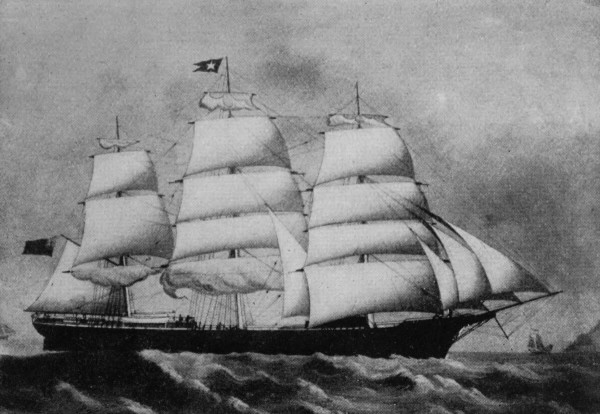
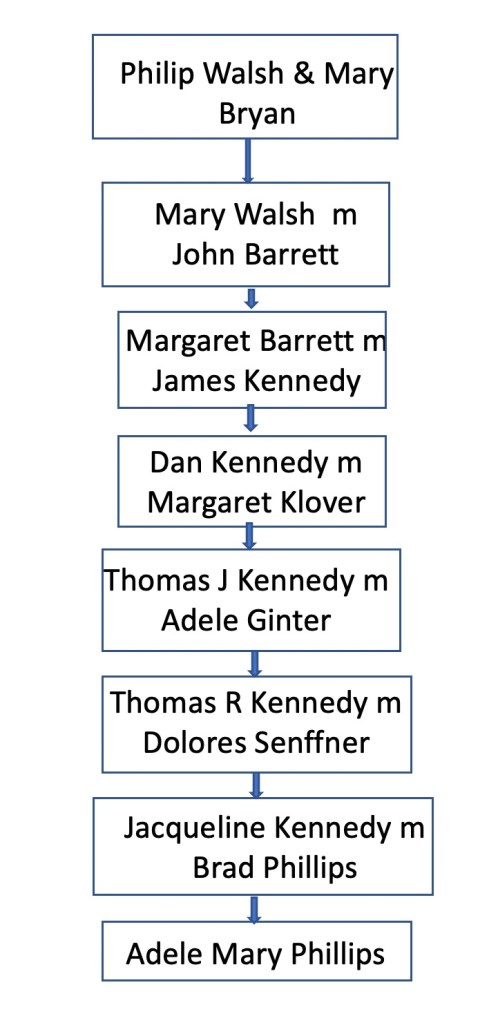
Mary did board a ship, the “Star”, from Liverpool and was assigned to Cabin 3. The ship’s captain was Stephen E. Glover from Liverpool. The self-described spinster, known as 27-year-old Mary Walsh, arrived in the Port of New York on May 11, 1836. Four years later, she married John Barrett, formerly of County Cork, Ireland and gave birth to John, William, and Margaret. They lived in New York nearly 16 years, and then moved to Section 35 in Florence Township in Will County, Illinois in 1855.
Mary and John’s daughter, Margaret, married James Kennedy, my great grandfather in 1864. James, the son of John Kennedy, was from Ballingarry, Tipperary, Ireland. John and Catherine Corcoran Kennedy, had arrived in America in 1856.
The Tale of Two 27-Year-Old Women
I couldn’t help but think about the young Mary Walsh who, at the age of 27, made a decision that altered so many lives. With a minimal education, she probably never travelled more than a short distance from her home in Waterford before she left for a several thousand-mile trek.
Any comparison with a current American woman would be grossly unfair, but I did think about my granddaughter, Adele Mary, who is now 27-years-old. Addee has a master’s degree, has taught high school math for five years, studied for a semester in Limerick, and toured Australia.
Addee’s 4x great granny Mary would be amazed and proud of her 4x great granddaughter. Without Mary, there would not be an Addee. (Or me, as a matter of fact.)
Additional Notes of Interest
Mary was born in 1809, same as Abraham Lincoln. She left Ireland in the same year, 1836, that Wilmington became a city. When she arrived in New York, Andrew Jackson was president and would be succeeded the next year by Martin Van Buren, the first president born in the United States.
Thanks
Thanks to the late Loretta Kennedy Tulley for her wonderful notes and letters about the early Kennedy connections. I sat with Loretta many times as she talked about our shared relatives. In addition, I met with Gayle Schutten, Alice Kennedy, and Mary Turan for other insights on other occasions. Other information came from the “Will County History: Past and Present” book. A special thanks to my Tipperary friend, Kathleen Fanning, for her editorial contributions.
I look forward to writing stories about many other Kennedy, Klaver, and Ginter ancestors in the future.

 Braidwood Beginnings
It was fun listening to Mary! I feel like I know her a bit better. Thanks for sharing!
LikeLike