“Canopy defined: A canopy is a type of overhead roof or else a structure over which a fabric or metal covering is attached, able to provide shade or shelter from weather conditions such as sun, hail, snow and rain.“
- Place: Braidwood Recreation Club (BRC)
- Date: Summer, 1954
- People: Tommy Ray (age 13) and Carole Ann Kennedy (age 11)
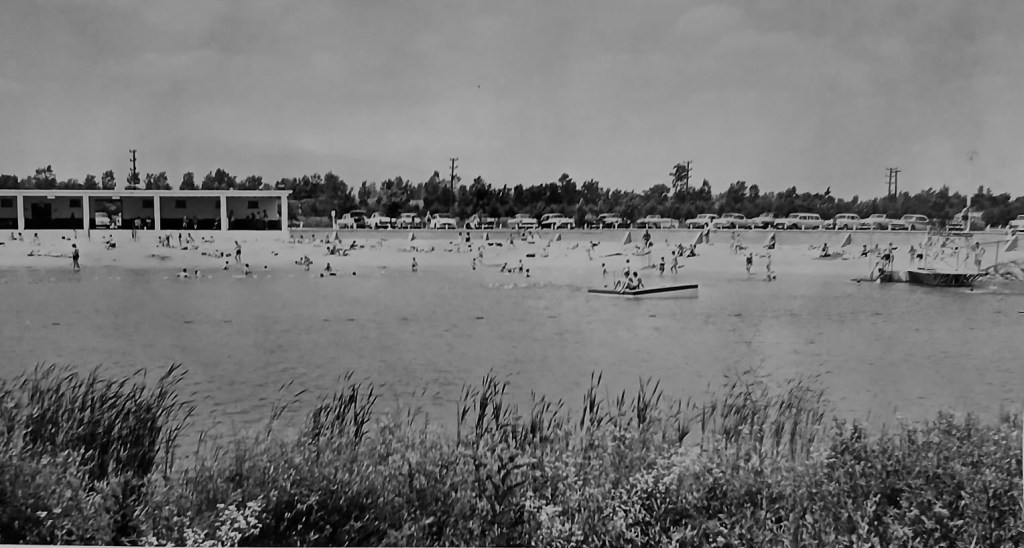
“Today is a typical early summer weekday for my sister and me. We have been living on Braidwood’s East side of town for a year and still discovering new places to explore. I graduated from the 8th grade at St. Rose in Wilmington and will be attending Joliet Catholic in September. Carole Anne will be entering 7th grade and our little brother, Kenny Joe, is too young to join us on today’s one-block bicycle ride through an unfenced back side of the Braidwood Recreation Club.
It will be hot today with possible thunderstorms so we want to get to the beach before noon and enjoy the still-cool waters of the old strip mine pit that was converted into a top attraction for the area. I carry a towel wrapped around my bathing suit and we head across the road and within 10 minutes reach the covered building that includes the two changing facilities and a snack bar. We park our bikes, change into our bathing suits, roll up our clothes in the towel, set them on the sand against the beach wall, and are into the water within 10 or so minutes.
For the next hour, I have found some of my buddies and we toss a ball back and forth, swim to the raft, and practice our underwater swimming. Life guards are on duty and ready to eject anyone who is violating beach rules. (Like pushing someone off the raft or swimming beneath the raft where there was an air pocket.)
Then we hear the announcement of a mandatory break time and we all have to get out of the water. Fortunately, the break time coincides with a thunderstorm which will require us to retreat under the cover of the building. While we linger under the roof, or canopy, I notice that many of us have the beginning of sun burns, not just tans.
I also remember that all of us are white-skinned and that none of my Black friends are allowed to be here.”
Becoming Fully Aware
My consciousness of discrimination based on skin shades started early in my life in Braidwood. As I read more history about segregation and then witnessed outright racism during college, I fully accepted the facts that our United States had still not made sufficient progress toward the Constitution’s freedom, liberty, and the common good.
My ancestors, like all immigrants, came to the U.S. in order for their descendants to have a better life. As with all newcomers, they weren’t initially welcomed with open arms and respect. But they did have the unearned advantage of being able to “blend in” with the dominant society after a generation or two.
At the start of my ancestors’ arrival to this new country it was customary for them to ally with fellow immigrants of the same nationalities. They formed their own shelters, or canopies, until they could be protected and acclimated to the new environment. They depended on one another.
On a much larger scale, it became self-evident that all of us actually need and depend on one another in order to survive. The BRC canopy that protected my swimming companions, my sister, and me had become the “humanity canopy” that includes everyone on the planet.
Observation
Not every human being possesses the same degree of empathy for others or the understanding that we need one another for survival. The story of mankind is a litany of war, peace, love, hate, selfish, and unselfish. Fortunately, our history since the beginning is a testimony for muddling through and correcting mistakes.
What do we all have in common? According to scientists, all humans are 99.9% alike, just variations of one another. However, we tend to emphasize our differences, mostly physically differentiating features. We all need food, we adapt to the environment, we reproduce in order to ensure our species, we think and learn, and we evolve. But, most of all we need and depend on one another.
It is under this rubric of need and dependency that we have established a common good for one another and for all living things. We can call this “being human.”
Being human drives us innately to the primary instinct to care for one another. It is contrary to our very nature to do harm to other living creatures unless in self-defense or survival. Some may call this human principle empathy, behaving ethically, or being “humane.” Thus, we all live under the “humanity canopy.”
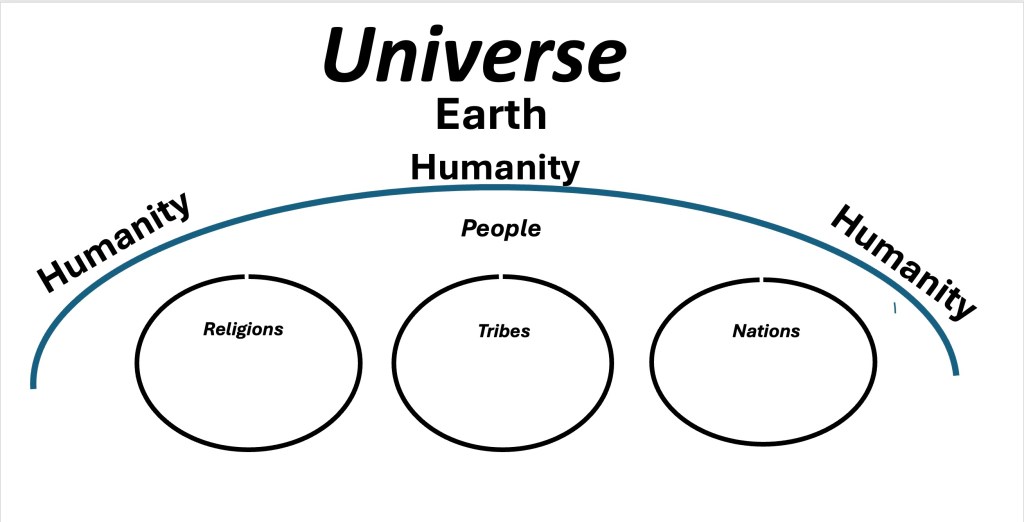
Beneath this Humanity Canopy lay all human beings. But we have created subdivisions based on social constructs and geography. These subdivisions bond as defense alliances or tribes such as: nations, gangs, religions, political parties, unions, ideological units, and geographic boundaries. Their general purpose? Strength and safety in numbers.
“Inherent bias draws us to our own tribes.” Joy Andrews Hayter
While assuring individual protections, these alliances or unions have a natural predisposition to view other groups as different, “lesser than,” or threats. They may even see others as sub-human. On an extreme, they may determine that the others should be eliminated, not realizing the fact that all people are very much (99.9%) alike.
“When violence rises in the Middle East, an even quieter tragedy unfolds online: people from different nations denying each other’s dignity, speaking as if entire communities can be erased with a single sentence. This is why we must return to the language of the cosmos. Astronomy reminds us that among trillions of worlds, you will never find another creature quite like a human being. As Carl Sagan taught, we are rare, fragile, and astonishingly alone together. So live gently and allow every peaceful belief the space to exist. On this small, pale world, our only true companions are one another.” Armin Motevaghe

 Braidwood Beginnings