“Everyone has a story”
One of my greatest pleasures is to engage a conversation with a total stranger, at the coffee shop culture, in an airplane, on the bench in the mall, where ever the opportunity presents itself. These strangers tell me their stories.
This story, however, is about my experiences over my lifetime. It is intended primarily for me and my family but may be of interest to others who have led lives that don’t hit the news media but nonetheless could tell similar stories. Like most of you, my peak experiences are more numerous then my valleys, but neither qualifies as momentous in the eyes of the public at large. Given the time and inclination, many others could tell personal stories that are far more interesting than mine.
Socrates said that “the unexamined life is not worth living.” And for many years, family and job obligations – usually self-imposed – have you legislated against serious and regular reflections. Over the past 20 years, I have found myself to be paying closer attention to reflection time and to document those reflections.
Most recently, I found myself as the leader of a small, not for profit organization, that resided within a Jesuit university, Regis University of Denver, Colorado. With the help of several key people, I was able to grow an idea that has produced and generated ways for educational institutions and their students to achieve more of their respective potentials. Over 50 years ago, when I graduated from college, I had absolutely no idea that I would be in that situation. I certainly had no idea what Braidwood had meant to me at that time. Now I do.
Braidwood, Illinois
If you were to look at an Illinois map, you can find Braidwood along I-55 just 20 miles southwest of Joliet. With a population of approximately 1,200 in 1950, Braidwood would not qualify for identification on a map of United States, but would, even at that time, rate some mention in regional journals because it was the birthplace of some historical, newsworthy individuals. Anton Cermak, a mayor of Chicago in the 1930s, worked as a youngster in the coal mines. You might remember that Cermak was killed in an assassination attempt on federal FDR in 1933 while in a car caravan. John Mitchell, a United mine workers leader whose statue stands in Scranton PA, had similar work experiences in the mines during the early 1900s.
While diversity was hardly evident in most towns the size of Braidwood, there were some diverse resident populations in the city. Imported from West Virginia in the late 1800’s, Black mine laborers got off the train in Braidwood to work the mines during a strike situation. Mine owners may have been remiss in not telling them that they would be strikebreakers, but only told them of employment opportunities. In the 1940s forties and 50s, there remained several black families who were active citizens in Braidwood.
The mines attracted other ethnic groups, such as Bohemians, Italians, Germans, Irish, Scottish, and English. As mining gradually receded, many of these people sought other employment or moved away to new opportunities.
In 1950 and before the interstate road system, Braidwood was dissected by route 66. The amount of traffic along that famous highway necessitated the installation of a four-way stop so that locals could navigate from the west side to the east side.
My Earthly Arrival
My entry into the world in general, and to Braidwood in particular, occurred on October 8, 1940. Dad was a farm kid from near Wilmington and mom was raised between Wilmington and Elwood in a house that had route 66 in the front yard and the railroad in the backyard. Mom’s father worked for a pumping station near Elwood.
Dad was the 3rd to the oldest of five children and mom was in the middle of eight children. Dad’s family was Irish/Dutch and Mom’s was German. Mom’s mother died at age 52 and dad’s mother died in childbirth at age 35. Both mom and dad were considered “good looking,” so it was natural that their family situations and their attractiveness pulled them toward marriage.
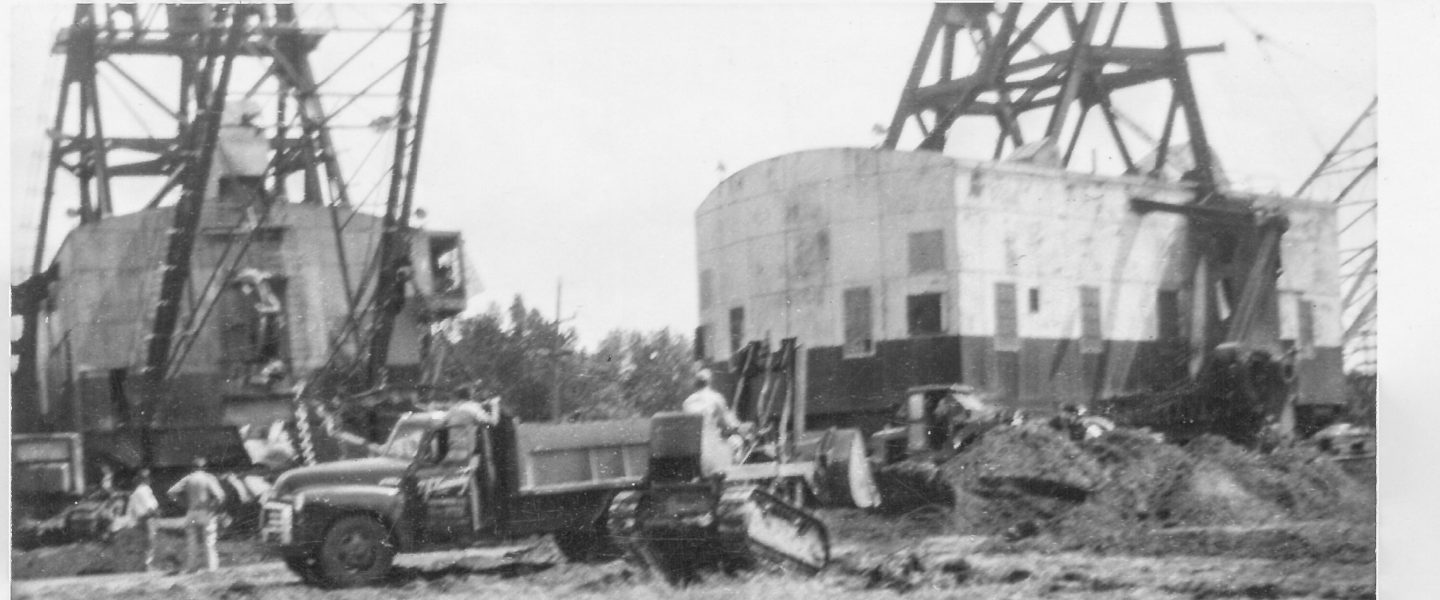
So, I came into the world of Braidwood and although I stayed there until I was 21, Braidwood has always been a distinct part of me. My early world consisted of: a sister born in 1943 and a brother born in 1949; my self-employed father’s business as a truck driver/heavy and light equipment operator; a baseball field adjacent to our house; and my mother’s total preoccupation with us kids. Later, my world would expand to all of Braidwood, the church, school, and weekly trips to Wilmington and even Joliet. My world was expanding.
I find it impossible to separate myself from my early Braidwood years. In fact, Braidwood is more a part of my conscious self than ever before. Small town streets, stores, houses, employers, and people represented not only my early years, they were the foundation for my entire life. Besides Main Street and Walker Street, I could hardly remember or name any of the other streets. Walker Street was a gravel road where my second house – the one I remember best – was located on this street. All of the other streets were nameless for me because we never bothered with street names. Only family names and houses were referred to. Sections of the town were identified as lower Braidwood, the east side, or downtown.
The View Around Me
Merchants and other businesses were easily identified because of their relatively small numbers and significance as workplaces. The post office on Main Street, Grinchuck’s pants factory, Rossi macaroni factory, the Peabody coal company, the Braidwood recreation club, and the Rossi Motel: they were the primary local workplaces where residents had jobs.
Merchants, including taverns, or landmarks were more easily identified than streets. Taverns where my dad frequented, many times accompanied by me, were numerous, considering the total Braidwood population. Barnett’s, Dillon’s, Dixons, McElroy’s, Spitty’s, Baber’s, and the 13 Club were some of the local watering holes. I was in all of them at one time or another.
Merchants of other consumables probably were typical of any other small town. Grocery stores included Shaughnessy’s, Joe Testa’s, Scotty Dalziel’s, and the lower Braidwood grocery store.
Kate Jackson’s store and Davito’s sold hardware and other household items while two major gas stations were McElroy’s and Barnett’s.
Other employers were the public schools and the Braidwood recreation club. In the late 1940s, I was aware of three public schools: Reed Custer high school; the lower Braidwood elementary school; and the East side elementary school. The most significant employers were the Pants Factory, the Rossi’s Macaroni Factory, and Northern Illinois Coal.
With the leadership of M.J. Donna in 1949, the Braidwood Recreation Club was developed over several hundred acres of “spoils” or reclaimed strip mine areas. Comprised of man-made lakes up to 60 feet deep and hills probably not higher than 300 feet, the BRC became a mecca for recreation for people within a 30-mile radius. It was, and remains, a private club that has a cap on membership numbers, but automatically qualifies Braidwood residents after a certain period of time. At one time, there were no minorities as members, but I have been informed that now there are minority members.
Surrounding My Town
Within a 5-mile radius of Braidwood were the small towns that maintained their own identities. To us, Wilmington was the upscale town 4 miles north. It not only prided itself with the major river, the Kankakee, running through it, it also had not one, but two movie theaters, the Mar and the Wilton. Wilmington also has a thriving downtown area that to my eyes literally bustled on Saturday nights. A dancehall, several restaurants in town taverns, a hardware store, confectionery, drugstore, and shoe and clothing stores were all within a four-block walk along Water Street. Going to Wilmington on a Saturday night, and even getting the Sunday paper, was a big event, especially since both mom and dad, and many relatives, were from Wilmington. The paper mill and the Joliet Arsenal were major employers for many residents.
Wilmington also had an active Catholic church, St. Rose, that started a grade school in 1948, which I attended from the third grade through graduation. My first two years were at the East School in Braidwood where Miss Cowden was my teacher.
To the south of Braidwood only 2 miles away, were Godley and Braceville. Godley was the more famous because of the Mafia-controlled house of prostitution. In my college years, my Chicago fellow students would only know of Braidwood as being the town just north of “Godleys” as they referred to it.
For me, Braceville was rather nondescript, and Gardner was where Fatlan trucking and Hank’s Drydock Tavern were located. South Wilmington was a farm and mining community populated by many Italians. Just north west of Braidwood was a series of villages and towns, seemingly connected with one another but maintaining their own distinctions. Coal City was connected to the shaft mining communities of Carbon Hill, Eileen, and Diamond. My uneducated impression was that Italians were the most significant population.
With the possible exception of Wilmington, with a population nearing 2000, none of these towns exceeded 1500. In the case of Godley, only about 200 residents were permanent although they probably had 100 times the number of male visitors over a given period of time.
The People of Braidwood
Of far more importance to me than the features and characteristics of Braidwood and its surrounding towns, were the people. I assume that every small town has a cast of characters but that only later in life does one realize their importance and their uniqueness’s. As I grew up, I took them for granted. They weren’t special at that time, but I now realize how unique and significant they were to me.
Because I delivered the Herald-News to a wide population in town, I became acquainted with them as I delivered and collected money. Collections were due every other week for $.35 cents per week. As with many customers, Suzie E. was dirt poor and living in a ramshackle house that had no indoor plumbing. But Suzie always managed to scrape pennies and nickels together to pay the $.70 cents. I seldom had to go back a second time, unlike the more well-to-do customers who would tell me to come back later. That taught me a lot.
Nicknames?
Nicknames were as common as mosquitoes in Braidwood, and I am sure that they caused a lot of discomfort to some of those tagged. Some names were innocent enough while others probably hurt. Regardless, these nicknames clung long after their reason, to be erased only if the person moved away from Braidwood. Some nicknames were decidedly ethnic, while others were from childhood or incidental to an event. Keetsie, Kaco, and Guido happen to be Italians. Bodie was probably an abbreviation. Tofie, too.
Other characters were also easily identified and remembered. Dolores and Jackie Martinetti, Joe and Andy Berta, Ronnie Flint, Joe Munch, Jungle Jim Zboril, Squeaky Dennison, Chewy Mulligan, Moon Mullins, Termite Lazier, Red McElroy, Sonny Boy McElroy, Gene “Moon” Mullins, Scotty Dalziel, Ed “Bender” Voboril, Lulu Nielsen, Clue Jones, Little Nancy Spiezio, Killer Koslowski, and Mud Pinnick were a few of the popular folks around Braidwood. I considered all of them as friends.
Influencers?
Beside my own immediate family, there were several other influential people who strongly shaped me in early years. Mrs. Sarah Jeffrey was almost a grandmother to me and lived on Walker Street. Mary and Olaf Dahl were half a block away. Living next to the baseball field afforded me the chance to play baseball with Barney and Mike Faletti, Richard Bone, Danny Turner, Buddy Pinnick, Dennis Mahler, Colin Kelly, Larry Bennett, Buddy Perona, Bob Wilson, and Pete Cinotto. They were all kids I grew up with in the late 1940’s and early 1950’s.
Other influences came through my father. “T.J.” as he was known to his friends, T.J. was popular and gregarious. I rubbed shoulders with his friends on various job sites, restaurants, and bars. They played cards, drank coffee or beer, told jokes, and worked. T.J.’s friends helped formed a young boy’s philosophy of, and outlook on, a life that provided the basis for future actions. That, together with mom’s less cynical, but equally effective, view of the world formulated my approach to a life that would later be complemented and expanded by a singular giant, Coach Gordie Gillespie.
Of T.J.’s companions, a few emerge as the most prominent influences. Dad’s brother, Ray, epitomized gentleness and simplicity. Dad pretty much raised Ray after their mother died at a young age. Albert Crater, like Ray, was a World War II veteran but unlike Ray was full of stories and jokes and was always ready for laughter and a wide smile. Leo Fatlan was another World War II vet and a close companion of T.J. Leo learned the trucking and construction business from dad. Other friends and companions were Ray and Al Rink, Cliff Muncie, Bob Lamping, Dean Onsen, and Uncle Nick Van Duyne.
As stated before, dad’s friends had a significant influence on me. I was with them and T.J. mostly on the job sites but listened intently to them at their leisure in the bars and the restaurants. In many ways, they became role models – for good or ill – but mostly good.
To this day, I find myself most comfortable with people who do real labor, construction or otherwise. If a counter is available in a neighborhood restaurant, that’s where I sit. If the restaurant serves cappuccino, I’m in the wrong place. It doesn’t matter if the guy next to me is black, Hispanic, or white, I will always send out signals that I’m open to a conversation.
Mom’s Friends
Mom, on the other hand, seemed to have had fewer close friends that I was aware of. Her sewing business came in her later years so most women with whom she talked were relatives.
Aunts Helen, June, Mary, Kate, and Alice – all sisters – provided a core group that sporadically enjoyed one another’s company. I say sporadically because of their common disagreements that would cause a cessation, sometimes brief and sometimes lengthy, of their friendships.
Mom’s closest friends during my early years was Sarah Jeffrey, who lived in the small house across the street from our house on Walker Street. Mrs. Jeffrey became a guiding star, a mentor for mom. Mom’s mother had died when mom was only 18 years of age, so she did not have a mother relationship during a critical period when she had children. Mrs. Jeffrey was also a grandmother figure for my sister and me during these times and counseled mom when we suffered the usual childhood diseases. Only an older, experienced mother could advise and support. That was Mrs. Jeffrey.
Mrs. Jeffrey also leaned on mom for help. Mrs. Jeffrey worked in Joliet during the week where she was a house keeper for and even older woman, then returned via a bus or train to Braidwood where mom would pick her up at the station. She was a gentle, loving woman who had immigrated from England when she was quite young and married a man who worked in Braidwood’s coal mines. Her daughter, Louise, taught school in lower Braidwood, married Ted Taylor, and moved toward Chicago. In a way, mom became the second daughter to Mrs. Jeffrey.
Mom’s penchant for caring was also demonstrated by her dedication to transporting another older woman, Mrs. Kaiser, to Coal City doctors. Mrs. Kaiser wasn’t able to drive and needed a lift on a regular basis.
Character Builders
In addition to the camaraderie of T.J.’s friends, I learned compassion and personal sacrifice from mom. T.J.’s friends weren’t compassionless, but their strong traits were more collegial for the most part and coupled with competitiveness. It was mom who wanted my sister and me to take music lessons, an expense that our family could ill afford. It was mom who pushed us into the Catholic schools, and thereby set us in the direction that forced us to think outside our narrow geographic boundaries. It was mom who influenced me to grow beyond a limited career path. But it was dad who never let me forget our roots.
It was mom who sat with us in the car on Wilmington’s Water Street pointing out the different characters who passed by our windshield while dad had a few beers in the tavern. But it was dad who, while we were by ourselves, took me into those taverns and introduced me to a whole different culture.
It was mom who made me promise never to smoke a cigarette, while dad continued the habit which later contributed to early death. It was mom who seldom missed church services and had a faith that extended past the mortals who ran the church. But it was dad who had a healthy cynicism and who seldom attended services while having a very cynical view of the priests who believed they were superior.
The combination of Adelle and T.J. formed a balanced foundation for a son entering into high school in 1954. My tendency at that time was to follow the more structured reverential path of my mother, but echoes of T.J.’s voice rattled around my mind until they surpassed my mother’s more faith-filled approach. Of course, Vatican II did not help mom’s outlook.


You missed probably the largest local employer,. McElvain Coal Company. I knew at least a half dozen people just in our nearby neighborhood who were employed there, including Syl Fallada, Joe Kelly, Jimmy Kilpatrick and my father. The tipple was adjacent to south Center street. I never did know the reason Mrs. Fallada felt so strongly about the new family ( the Kennedys) in our neighborhood. Among other stories.
LikeLiked by 1 person
Thanks, Jack, you are correct. My dad would also be involved at the coal company, hauling coal to Interlake Industries in Rockdale. Joe Kelly operated one of the draglines. What did your dad do at the mine? (BTW: Syl Fallada probably was a decent guy, but we never knew him very well. I don’t think he liked the snotty-nosed kids next door to him.) Keep the comments coming, Jack. You knew Braidwood as well, or better, than I did.
LikeLike
The reason Syl and Ann Fallada didn’t like us was because they wanted their friends to buy the house and my Dad and Mom bought it instead. They were not happy about it because there were 3 kids and a dog and an inherited cat. And we were not the sweetest kids. We suspected they poisioned the cat and retailiated like only 3 snotty kids could. I am sure we were annoying!
LikeLiked by 1 person
My dad worked with Syl at McElvain’s coal mine but enjoyed more than a few beers with your dad, so had to walk a thin line of friendships. Annie began plying the Hornberger kids with Brach’s candies when you moved in. That consisted primarily of Bridge mix and Non-Parielle–awful choices and really cemented the alliance with the Kennedy clan.
LikeLiked by 1 person
Howdy!
Just finished editing this document. I’ve attached it as a separate document.
How I love hearing the names of people I knew from so many years ago! Your writing is so down-to-earth!!!
There are a couple of words/letters in RED that need your attention.
I’ll be heading to Braidwood tomorrow for the BAHS’ monthly meeting. I so enjoy our meeting discussions and visits with people who stop by to see the artifacts.
CHEERS!
Dee
LikeLike
This was so entertaining. Our family (The Shepherd Family) lived on Oak Street in Braidwood from 1957-1066. We lived in a big ole white two story house that had two apartments on the second level that was rented out. We had so much fun in Braidwood on our bikes and going to the Dairy Queen where my older sister Suzanne was a car hop. Once we convinced our parents to let us all ride our bikes to Wilmington. We were probably 8 or 9. Once we got there we wished we hadn’t done it because we were exhausted:) Daddy worked at Amoco Chemicals (a Standard Oil company) in Joliet all those years. In fact his entire career was with Amoco/Standard Oil. We left Braidwood in 1966 when he got transferred to Decatur Alabama.
LikeLike
Send me an email to tkennedy@braidwoodguy.com and we can talk about this.
Tom
LikeLike
JUST NOW HAD A CHANCE TO READ YOUR ARTICLE FROM JAN.2021.
I WAS RAISED IN BRAIDWOOD UNTIL ENTERING THE SERVICE IN 1967.
I’M THINKING YOU MAY BE A FRIEND OF MY COUSIN (KEN NELSON).
I MET GORDON GILLESPIE,AND PAT SULLIVAN THROUGH KENNY AND I’M RECALLING HEARING YOUR NAME IN SOME OF THOSE CONVERSATIONS.
I TRULY ENJOYED RECALLING OF THE PLACES AND NAMES MENTIONED IN YOUR WRITING.
THANK YOU FOR SHARING AND ALLOWING OTHERS THE PLEASURE OF RECALLING BRAIDWOOD OF YEARS PAST.
I’M WONDERING IF YOUR YOUNGER BROTHER ( SORRY CAN’T RECALL NAME)
WAS WHO I REMEMBER AS A MASTER OF PAINTING MOTOR SCOOTERS?
BEST REGARDS,
TJL
LikeLike
Thanks for the message, Tom. My brother, Kenny, remembers you. I just talked with him today. Your mom and Ken Nelson’s mom sisters?
LikeLike
Tom,
Thanks for the reply, yes my mother and Ken’s mom were sisters. As a teen ( Pryor to the military) I worked at Lolly’s Steakhouse and at the Polka Dot Drive in as one of the original employees!😃
I’m sorry your brother’s name escaped me, however I’m hoping my memory served me well recalling him as an artist in car and motorcycle painting??
Ken’s father started Nelson’s Royal Blue grocery , later to transition to today’s Nelson Furniture, where I worked briefly after my service time. Went on to work for Turk Furniture, and later moved to La Salle Peru area and owned and operated my own Furniture business until retirement.
Can’t tell you how much I enjoyed your article and came shortly after a time when one of my sisters forwarded an article about Rossi’s macaroni factory!
Although I’ve been gone from Braidwood for over fifty years, we still return to the Abraham Lincoln National Cemetery ( where my parents are in rest) and still make an occasional stop at the Polka Dot and Faletti’s meat market.
I have not seen my cousin or Pat Sullivan since a breakfast get together, and trust and hope they are doing well.
Thanks once and again for sharing and allowing me to do the same!!
LikeLike
Thanks, Tom, for sharing part of your history. An update on Pat Sullivan and Kenny Nelson (Nellie). I talked with Pat just today and he is recovering from a second case of Covid. This, after another back surgery and two knee replacements. Kenny has also gone through several health-related problems but seems to be doing ok. Both Pat and Kenny use walkers to get around.
Where are you located now? Would you ever be interested in writing a short piece for Braidwood Guy?
LikeLike
Thank you so much for the trip down memory lane. My grandparents were Red and Grace McElroy and my dad Kenny Knorr and uncle Joe Sonnyboy McElroy owned the gas station downtown. So many happy memories of growing up in a town where you left you keys in the ignition of your car and never locked the the house. Every Saturday morning Grandpa took us all over creation and even had one of his buddies let us work one of the shovels in the strip mine. It always ended at the gas station where my brother, cousins and myself would play in the tire loft while the adults drank beer. And if we asked, we got a sip! Warms my heart thinking about it. Thanks again.
LikeLike
I sure do remember Kenny Knorr, Sonnyboy, and all the rest. Where are you now? in Braidwood? contact me at tkennedy@braidwoodguy.com.
Tom Kennedy
LikeLike
I enjoyed reading your history! Some of my ancestors were from Braidwood, and I’m into genealogy so maybe you will recognize some of the names and be able to help. I visited the Bohemian cemetery & the local library a few years ago trying to learn more about them as I am unable to find Braidwood census records on line for these family members.
I found a death notice from the Braidwood Index from July 1952 of an uncle James (Jr) Lavicka. It said his sister, Anna Sindelar (my gr-grandma) was still living there then, although we believe she went back & forth between Braidwood and Chicago. I’m not sure if this brother & sister were in the same house in 1952 when he passed. Maybe you remember them from delivering papers!
Their parents, James (Sr) & Anna Lavicka settled there in about 1882, they had 8 children. James Jr was their eldest son & Anna Sindelar (married name), their eldest daughter. By 1900 most of the family was in Chicago, but they must have maintained a home in Braidwood according the death notice. Ancestry.com does not indicate that James Jr ever married. Also, the family story goes that Anna Sindelar’s daughter, Helen Ritzenthaler delivered my aunt in Braidwood in Anna’s house in 1929 as my dad sat outside as a little boy worried about his mother’s cries. I have a picture of the house, but no address. Obviously this is before your time, but I’m assuming this is the same house she still had in 1952.
I also found a snippet in the Herald News from 1905 that Joseph Lavicka bought Lots 1, 4 & 5, of Block 26, of C & W Coal Co’s subdivision in Braidwood for $175. Not sure of the relation of Joe Lavicka though. When I was trying to research these lots is when I saw your blog!
LikeLike
Great to meet you, Julie. Yes, I recognize many of the names. My favorite memory is Earl Lavicka, a great guy and very knowledgeable about Braidwood. Is that “Singular” or Sinkular that you remember? I will check with my brother, Kenny, who still lives in Braidwood.
Tom K
LikeLike
Hi, Tommy… it’s Jackie. I remember the first time I ran across your “Just A Braidwood…” web site. It made me happy! My sisters and I love every memory we have of growing-up in Braidwood, and absolutely the Kennedy Family. Your Mom was a saint from heaven. I remember her trying to prepare a few of us St Rose girls for a Mothers Day program at Immaculate Conception hall. We sang “MOTHER”…. we were unforgettable. Every live Christmas tree search I’ve ever since had relives the time you, or your Dad, took us in the big truck to cutdown our trees. Ours was so big… Pa had to cut it down, down and down a bit more to fit it into the front room. Merry Christmas to your families, especially Carol and Kenny. Thanks, Jackie Ashford.
LikeLike
Great to hear from you, Jackie. My email is tkennedy@braidwoodguy.com. I need to hear more about you and your sisters.
LikeLike