“Creative ideas come from marinated observations of the obvious.”
TK

Looking back to my days of teaching and coaching at Roncalli High School in Aurora, Illinois, it is easy to see the genesis of a highlight in my career. That highlight, of course, was the Lewis University intramural program which involved hundreds of students eagerly and enthusiastically competing in sporting events.
Roncalli, a new, all-boys secondary school where I periodically resided and presided for four years, was populated with kids who were not necessarily enthralled with learning about literature from a lanky, skinny former athlete. They had loads of energy, combined with emerging adolescence-hood, and sitting in a classroom was not their prime interest in life.
As a coach and teacher at this Christian Brothers’ school, I knew that sports were top on their list of thoughts, followed by hallucinations of females. Literature and other subjects were at the bottom, except for a few, more cerebral boys.
Now, that is not to say one could easily divide them into just two categories. Some of the brightest students were also good athletes and some who struggled academically were more concerned about cars. In other words, they represented all types of 14-17-year-old boys between 1962 and 1966.
Lunch time lasted for 40 minutes, which meant that peanut butter or bologna sandwiches were consumed in about three minutes, washed down by a small carton of milk. That left about 37 minutes for goofing around and horseplay. What to do with this bundle of hyperactive students?
Intramural sports in the gym or on the field was the solution. It could be homeroom versus homeroom or teams picking up sides, yielding to the primal instinct of “tribalism.” By the end of 37 minute “lunch time,” more energy and enthusiasm were demonstrated than a semester’s worth of poetry or grammar usage.
The athletically gifted, as well as those who were challenged, all seemed to be consumed by whatever sport it happened to be. I saw where the least-gifted athletically boy could be a hero for his team by scoring the winning goal and the superb athlete congratulate him. It seemed like individual and team sports could engage almost everyone in a positive way.
How to fuel and expand on this phenomenon? How to capture this desire for healthy competition that involves more and more kids?
Athletic feats and recognition go hand in hand. A newsletter was an obvious answer. That newsletter was called “The Competitor.”
Fast forward to 1967-68 at Lewis College, where I became co-director of intramurals alongside Paul Ruddy. Paul had been a one-man gang directing the intramural program while also being head basketball coach and faculty member. As the new soccer coach and assistant baseball coach, my duties complemented Paul’s other jobs. He and I shared the fall activities, I took the winter sports, and he took over the spring sports.
Paul was a great colleague/friend and knew much more about physical education and intramural structures than I did. My idea was to create as much enthusiasm and information-sharing as possible in intramurals through the media of that era. (Mimeograph and manual typewriters.) We were both blessed by the dormitory structure of “houses,” the fraternity system, and other student organizations. Plus, Lewis students were generally from the Chicago suburbs and Joliet where sports ranked supreme.
It was a natural to incorporate these elements into a dynamic, evenly matched system of competition. A newsletter, “The Competitor,” might complete the picture.
“Intramurals were a central aspect of campus life during the mid-to-late 1970s. It seemed that everyone looked forward to the IM leagues and activities… It is important to recall that by 1978 The Competitor served as the only newspaper on campus.”
Br. Mike Quirk, Director of Intramurals (1974-78)
“The Competitor” would ultimately be the vehicle for communicating the schedules, the results, the standings, and some commentary…pretty mundane stuff that could soon find its way into the nearest garbage can unless it could be made into a sports page, such as a local version of the Sun-Times, which nearly everyone read.
As such, the newsletter might even add excitement and intensify natural rivalries. How might we do that?
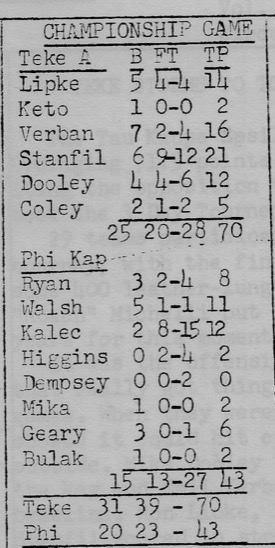
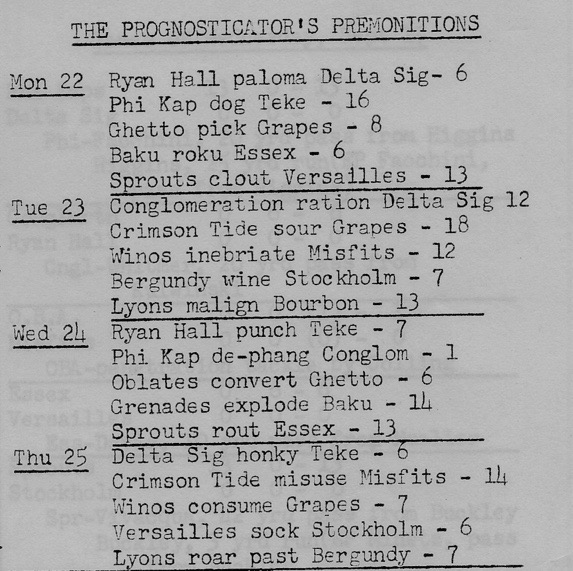
Everyone likes to be recognized with their names in print. So, box scores of all games were printed along with team standings. Game schedules could be made more interesting and remembered if predictions were included using colorful verbs rather than “vs.” An “All Sports Award” would be presented to the top organizations, frats, and houses at the end of the year which prompted each organization to compete at all levels. The divisions were gold, silver, bronze, and lead with the best teams entering into the Gold and the least athletic teams to be assigned to the lower divisions. Even the least athletically talented members could help their organizations.
“Perhaps the next most striking reflection on my life at Lewis during the golden years of 1971-75 is that one’s feeling of worth was not tied into your ability as an athlete. Don’t get me wrong, there were some great athletes. But those of us that loved the game and played IM’s instead of varsity sports still felt accepted. We had a place to go where we could shine. It was our limelight.”
Frank Palmassani, IM player, Coach, & Referee
The key to all of intramurals was to maintain competitive teams at all levels. “Loading up” was not allowed, but instead team membership was restricted to natural affiliation of an organization or house. Nobody enjoys losing, or winning, by huge margins.
Weekly team schedules became “The Prognosticator’s Premonitions” who would pick winners along with the point spread. Commentary was written in rhyme by “The Purple Poet.” No one but the Competitor Editor knew the true identity of the Prognosticator or the Poet.
The editor, along with student helpers, published “The Competitor” each Monday morning. Upper class students were referees, associate directors, coaches, and staff. The student body submitted team names that added spice to the program. (Some names were rejected, as you might suspect.) Many student athletes were identified and known with nicknames that were earned in a variety of ways. Therefore, the “Mole,” “Baby Fitz,” “Cocky Fitz” (no relation), “Faces,” “Cosmo,” and “Springs” became so widely known that few knew their real names.
“Tommy Cunningham would not shave for a week before the intramural wrestling tournament and then “chafe” his opponent into submission. I think he won his weight division all 12 years he attended Lewis.”
John Clark, IM Participant & Student Leader
Because of “The Competitor,” the intramural program became so popular that nearly 80% of the resident students were actively involved in one way or another. This meant that even the least athletically talented student could reap the benefits of dealing with success and failure, teamwork, and physical and mental exertion. The extracurricular became the co-curricular, where students learned more about themselves and others while developing lifelong relationships that endure 50 years later.
Of course, I received my share of benefits from being involved. I had the opportunity to learn more about the student body. It was evident that nearly everyone could benefit from being involved – regardless of talent. The program was not just for the elite athlete.
And the Competitor, having been conceived and hatched in Aurora at a small Christian Brothers’ high school, came into maturity at Lewis during the late 60’s and early 70’s. The editor never had more fun nurturing it.
After I left the athletic department and became dean of students, Mike Quirk continued an upward trend of intramurals for several years. Mike brought the program to an even higher level and continued “The Competitor.”
“I also know I am now addressing the greatest group of intramural athletes in the history of the United States. Our time was special. Playing basketball for Coach Ruddy and baseball for Coach Gillespie was fantastic but intramurals were something different because you represented the TKE fraternity and you couldn’t let your brothers down.”
Mike Slovick, IM Coach and Varsity Athlete
In a future blog, we will find out more about the characters called the “Purple Poet” and the “Prognosticator.” I think that you will find them interesting.

 Braidwood Beginnings
Tom,
I really enjoyed your blog article on intramural sports at Lewis. But you could have picked a box score of a game in which TKE didn’t trounce PKT in basketball!
Thanks for some great memories.
John Kalec
LikeLike
But you scored a lot of points, John.
LikeLike
John, I’m thinking about writing about our hometown as seen from different natives. Would you be willing to write something about growing up in Braidwood? Maybe 500-800 words that I might use in my blog? Let me know.
LikeLike