“There is nothing which has yet been contrived by man, by which so much happiness is produced as by a good tavern.”
Samuel Johnson
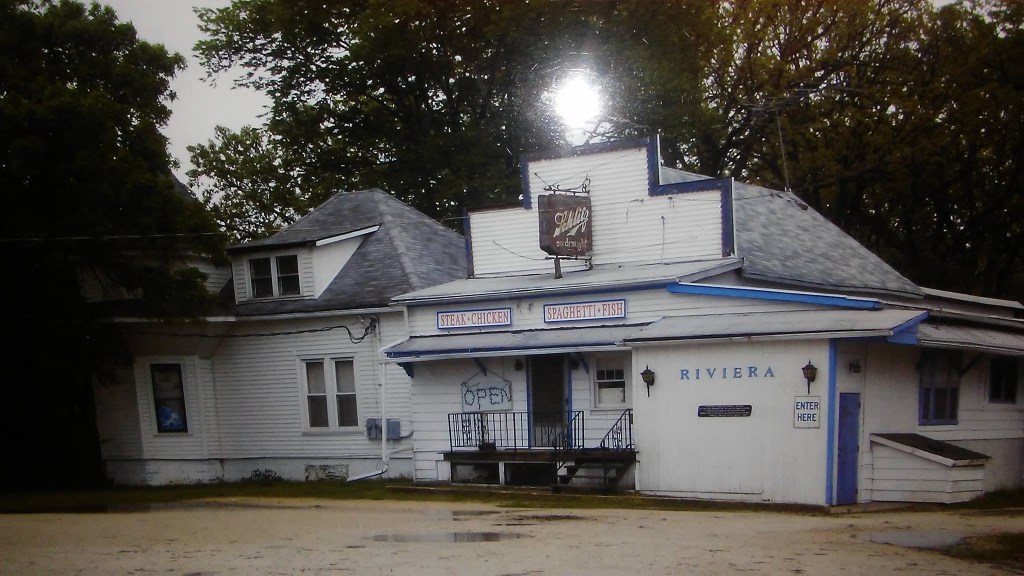
Why did dad and other men go to the bars? (And it was mostly men.) While I can’t speak to all men, I have enough experience to surmise why men like my father did while I was growing up in Braidwood in the 1940s and 1959s.
A Gathering Place
Sociologists might call bars gathering places, which served as a small community of men who knew one another because of their neighborhood proximity if not their common professions. Many were construction workers: laborers, truck drivers, carpenters, plumbers, miners, or farmers. Most worked with their hands and backs. From their different experiences, they knew how things worked. Each had his own particular expertise, but there was a commonality of basic knowledge.
That is not to say that they weren’t smart or intelligent. They reflected the same levels of intelligence as the general population, some smarter than others. My experience was that many never had the means to further their education because of finances or parents who didn’t place a high importance on schooling. I found some really intelligent, even brilliant, workers. Their intelligence often extended beyond their own endeavors.
While they admired book smarts, and wanted their kids to further their education, they would also take particular joy in ridiculing the college kid who didn’t know how to be practical.
Probably every small town, as well as the big cities like Joliet, had neighborhood gathering places we labeled taverns, watering holes, joints, or bars. Most were within a short drive or walk, and they differed according to the clientele.
Traveling with T.J.
Known as “TJ,” my dad was well known in in saloon society in the region, including our town as well as in Wilmington, Coal City, Gardner, Braceville, and Essex. Now, there were plenty of alcohol establishments included in this region and I can vividly remember being his sidekick in all of them. Whenever possible, I was dad’s little buddy in his truck whenever I wasn’t in school, delivering papers, or playing baseball.
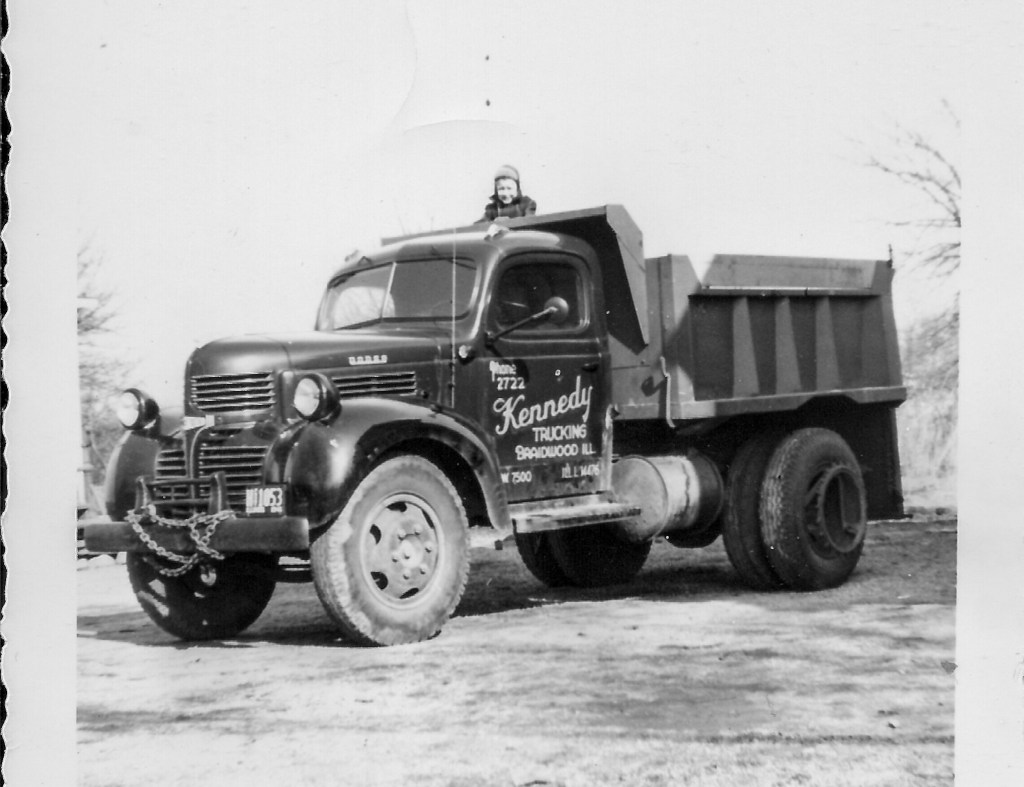
For me, these little ventures with dad were not usually in the evening. Most times it was at noon or right after the last job of the day. One thing about my father: drinking beer never interfered with his work as a self-employed truck driver. Rain or shine, hung over or not, he never missed work.
Saloon society was unlike going to church. For one thing, when you entered a saloon, you left your social status at the door. There is a defined seating hierarchy at church with the celebrant in front, totally in charge. Most bars are usually horse-shoe shaped, so there is no “head of the table.” Everyone has equal standing, sometimes literally when the bar stools are all taken. The tables are for euchre games, where 3-4 men might be playing.
All Bars Aren’t the Same
ThIs is not to say that all bars had the same status. Braidwood might be a good example. Going west from our house on the east side – where there were no taverns – down Main Street, you would encounter Barnett’s Lounge, then McElroy’s, followed in quick succession, Punk Dillon’s, John Dixon’s on your right and the 13 Club on the left. Lower Braidwood had its own set of bars, Spitty’s and Baber’s.
Barnett’s lounge was not dad’s type of bar, nor was the 13 Club where the term “cocktails” was assigned. No, his places were McElroy’s (later known as Stehlic’s, Crosman’s, and Kevin’s), Dillon’s, or Dixon’s where a beer and a “bump” (shot of whiskey) were most common. Sometimes dad would have a raw egg in his beer.
Some of these places had a pool table, a shuffleboard, and a juke box. In Gardner, Hank’s Dry Dock had an added attraction – slot machines in the back. All had card tables where euchre was the usual card game. Some featured beef sandwiches as did Wilmington’s O’Brien’s and Judy Kahler’s. Dad also spent time at Bum’s (Carbon Hill). Diamond Jack’s (Coal City), or at The Riviera (Braceville).
The tavern in Godley was the more specific. It was known for its Mafia-run prostitution house. Although my Lewis College classmates and teammates had never heard of Braidwood, they usually were acquainted with Godley. I explained where my town was: two miles north of Godley. (It was located on the County line. When the county police would come, ladies would run across the street to avoid being arrested.)
What’s a Boy To Do?
What did I do when I was in one of these joints with dad? Inside the establishment, there were usually 2-3 boys who had the same father/son status as I did. Like small clones, we imitated our dads at card tables, playing euchre and slamming down the right bower with righteous authority onto an innocent 9 of clubs. Or you might find us at the shuffle board, drinking soda pop.
And what did our fathers do besides nurse a beer? Usually, conversations at the bar were between those on the right or left, but occasionally from one end of the bar to the other, depending on the topic relevance. I can’t remember seeing anyone sitting at a table alone. Topics could be anything from scandals to politics to local sports. “How about Gene Mullins scoring 51 points last night against St. Paul of Odell?” “Is he better than Jim Touvelle? Jim was a helluva scorer in his day.”
“Small towns make up their lack of people by having everyone be more interesting.”
Doris “Granny D” Haddock”
Before Facebook and Twitter
The tavern was the social media of its day. Opinions were shared, rumors were verified, spread, or denied, and wisdom sometimes emerged. Customers were labeled as Hook, Porky, Scoop, Bender, Kaco, or Keetsie. The atmosphere could be cordial and welcoming but could shift to critical and stinging. I never saw a fight other than verbal sparring when subtlety could raise tempers. Unlike bars today, I seldom heard the vulgarity that is common now.
Braidwood bars with my dad provided an education that I still value. Similar to my experience of my early truck driving days, I became acquainted with men unlike those I later worked with in higher education over the past 50 years. Between those two classifications, I found geniuses and fools in equal proportions, but the men in the bar were easily identified and acknowledged. No one could fake it.
“In small towns people scent the wind with uncommon keenness.”
Stephen King

 Braidwood Beginnings
Gosh, this is so well written, and is an interesting topic from back-in-the-day, as well as current-day.
LikeLike
Thanks for making this blog readable and more enjoyable, Dee. You helped a lot.
LikeLike
The thing is, as I read this I remembered the smell and coolness of those bars. We would come in after spending time at the beach and play cards at a table in the back and if your Dad were there, you could have a small beer. Sure couldn’t do that today. It was a social time for the local men, meeting with their friends, but I know Mom wasn’t to happy about it. Euchre was the game played. You could always get free advice from the locals.
LikeLike
Dad must have liked you more, because I never drank beer. I got a pepsi!
LikeLike
Good article
LikeLike
My parents owned Dixon’s. As usual in those days our living quarters were attached to the back of the bar. My brothers n I were allowed to sit on the first 2 bar stools by the house entry. As bar owners our home housed the fire phone n whistle. My kitchen table is one of the euchre tables from the bar. Great memories. Thanks for sparking them.
LikeLike
I know, Judy. Lizzy and Johnny Dixon were fine people. I once entertained in the tavern by playing songs on my flute. I was about 10 years old. Unfortunately, dad didn’t tell mom, but she found out. She was outside in the car. Dad later paid the price, and I never played the flute there again.
LikeLike
My dad used to run at the bar in braceville named Effie’s and also the one one in godley. Unfortunately in 1978 Godleys bar was the last time he and 2 of his friends were seen. They all came up missing and was later found decease at the cooling lake in Godley. A family man, living husband and father of 8 children’s life was taken too soon. Do not remember my dad; all I have to go on is what others said about him. A loving, friendly and great person. He was at the wrong place at the wrong time. Just goes to show ya that friends aren’t was they perceived to be and it cost him his life.
LikeLike
Rosemary, I never heard this story before but I don’t doubt that it is true. This is very sad.
Tom K
LikeLike