Coach Gordie Gillespie seldom had only one coaching job. Beginning in 1951, he was coaching and teaching fulltime at Joliet Catholic and part-time at Lewis College. By 1959, Gordie was at Lewis full time, coaching basketball and baseball, athletic director, and teaching a full load of college courses as well as head football coach and teaching two courses at Joliet Catholic. He maintained those assignments through 1965 highlighted with a trip to the basketball NAIA national tournament. I know of no other human being who was able to carry such a load for that period of time.
Without fully realizing it, I was following a job pattern of my coach and mentor. For the record, I never had the talent and energy to ever be compared with Gordon Gillespie, but I did have a penchant for multi-tasking to a far lesser degree.
In the summer of 1970, the athletic director of Joliet junior College, Ken Parker, had a short-term need for a basketball coach and asked me to take over the reins for one year. I was full-time at Lewis as intramural co-director, teaching two courses, and assistant baseball coach. My wife and I just became parents to our 5th baby and we were living temporarily in a house on route #53 and Caton Farm Road. Our oldest child, Tom, would be 7 in November.
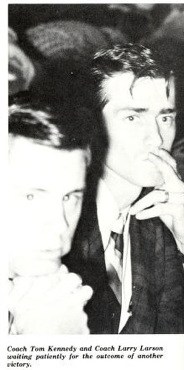
Joliet Junior College is the oldest junior college in the nation, and the “Wolves” had a reputation as having outstanding athletic programs. Several of their coaches, like Henry Pillard and A. A. “Fizz” Wills were national legends and Joliet icons. A.D. Ken Parker was another Joliet living legend whose reputation as a gentleman and professional leader was outstanding. Being associated with these people would be an honor, and I would take this job for a short period of time with the assistance of Larry Larson. Larry had also been assistant to the previous coach, Paul Siron.
This was a transitionary time for J.J.C. The College began moving from the Joliet Township High school facility where it was founded to the west side of Joliet on Houboldt Road during the 1969-70 school year. Now in its second year (1970-71), the new location was still being built as the school year started in September, with classes being conducted in a few newly built facilities and other administrative and classrooms in temporary buildings. The athletic facilities wouldn’t be completed until the following year. For the second year in a row, the basketball team wouldn’t have a home gym for either practice or games.
What did it mean to have a season without a gym? Home court advantage would be non-existent since almost all of these “home” games would be at neighboring high school gyms, not at our practice facility. In only one case did the team have familiarity with a part-time practice facility where a few of these home games would be played: Lewis University.
Practice primarily would be in the Joliet Armory gym (which was also a location for the army reserves’ drills and a part-time garage for trucks) with a few practices at Lewis. “Home” games would be played at Plainfield, Joliet Catholic, Minooka, and Morris high schools with a few games at Lewis University.
As part-time coaches, Larry and I would seldom be on the new campus. Athletic Director Ken Parker was totally in charge of scheduling of gyms, eligibility, travel arrangements, and communication with the College administration and academics. Basketball equipment (uniforms, training supplies, basketballs, etc.) would travel from one location to another.
In comparison with most college basketball programs, the 1970-71 team lacked many of the basic support systems besides a gym. Larry and I were in charge of the practice facility, equipment, athletic training, scouting, and sports information. That means that we swept the floor, taped ankles, drove the vans, and called in game scores to the Herald-News.
The team managed to handle the challenges and obstacles that confronted the JJC athletic program in stride with most of the credit going to each one of the players.
It was also an era in U.S. history that witnessed some of America’s most troubling times, the late 1960s and early 1970s. Joliet was not excluded from racial and Viet Nam tensions and our team was a fair representation of Joliet’s ethnic community. Throughout the season, while violence and serious confrontations occurred throughout the Chicago area, the basketball team never had a single racial incident. The credit goes to the team members.
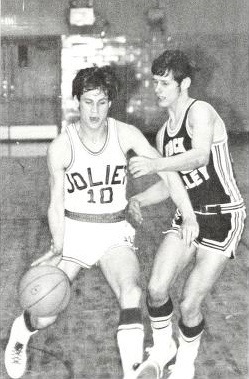
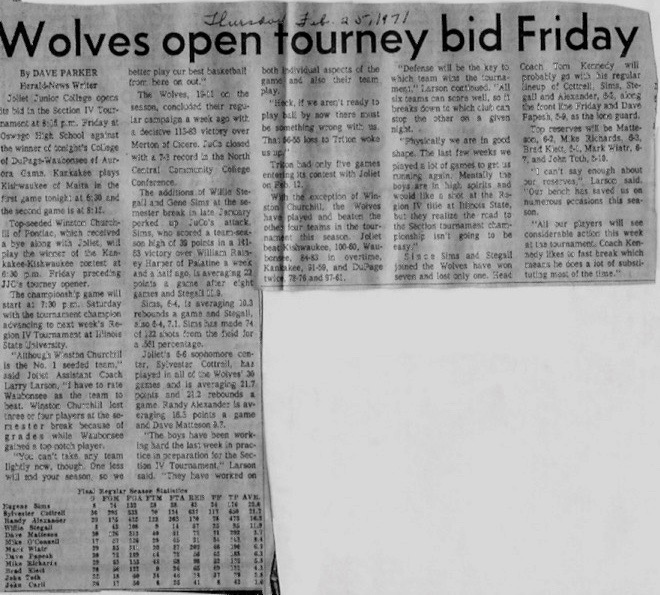
The roster included guys from the area high schools and varied in age and playing experience. They included: Eugene Sims, Sylvester Cottrell, Willie Stegall, John Toth, Dave Papesh, Mike O’Connell, Dave Matteson, Randy Alexander, Mike Richards, John Carli, Brad Klett, and Mark Wiatr.
Sims and Stegall, graduates of Joliet Township in 1965, would be athletically eligible in the second semester for our final regular season 8 games. Both had served in the army for two years and had a maturity that seemed to balance the team. Willie played with silky smoothness and grace while demonstrating a velvety shooting touch.
Eugene, on the other hand, had earned a legendary status for his jumping ability. On the Southside of Joliet it was said that he could dunk two basketballs from a standstill and “if you put a quarter on top of the backboard, Gene would leap to get it, and give you two dimes and a nickel on the way down.”
We struggled a bit during the first half of the season, especially when our point guard, Mike O’Connell suffered a season-ending knee injury, but several players picked up the slack. In the meantime, 6’6” center Sylvester Cottrell was having a career season with his rebounding and scoring.
As the second semester began and only a few games to go, the Wolves became an outstanding team with the addition of Eugene and Willie. Our backcourt lacked some depth with the loss of Mike O’Connell but the quickness and ball handling of Dave Papesh and the fire from lefty John Toth provided more than adequate generalship for the team. We also had an experienced bench with Brad Klett, Dave Matteson, Mark Wiatr, Mike Richards, and John Carli.
Enough cannot be said about the scoring and rebounding records of Cottrell (6’6”), Sims (6’5”), Stegall (6’4”), Alexander (6’3”), and Wiatr (6’7”). Syl averaged 20 points and 20 rebounds per game. There were some games when he pulled down over 30 boards and scored over 20 points. He dominated like no other big man. Eugene helped the scoring with 22 points per game.
Sylvester continued his academic and athletic career at Lewis University where he still holds the rebounding record (15.8 r.p.g. for the season and single game of 32). In 1972-73 his total was a standing record of 433 rebounds for the season. (In all probability, he also holds a record of having played for four different coaches in 4 years.)
Although we were beaten in our final tournament game against Robert Morris, the Wolves finished with a 21-12 record. (Not bad for having no home games.)
Highlights that were not in the Box Scores:
- John Toth made the season even more special. The fiery red head volunteered to tape ankles (he was the only one of us who had taken a taping class) and he joined me in the one time at Lincoln College where we both were tossed from the game. He also was ready to fight with the 6’8” Clyde Turner (Robert Morris) when Turner “accidentally” tossed 5’9″ John an elbow. John proceeded in punching Clyde in the back. Not John’s best decision.
- There was the team attitude of our players such as Brad Klett and Dave Matteson, who were starters until the addition of Sims and Stegall toward the end of the season. It should also be noted when one of our starters had forgotten his game uniform, it was John Carli who volunteered his to the starter. That had to be a real personal sacrifice.
- Larry Larson was more than an assistant coach that year. Larry became a good friend and companion during a time when the team and I needed all the help we could get.
- The era of the late 1960s and early 1970s was tumultuous in American society and politics. Our team had 5 African Americans and 7 “white guys” playing, practicing, and travelling together. To my knowledge, there were no situations where any significant racial problems emerged. That said volumes about the mutual respect that they had for one another.
- We were lucky to work with, and become friends of, the outstanding sports staff at the Herald-News. Sports editor Don “Hawk” Hazen along with writers Dave Parker, Neil Warner, John Koehl, Jim Thompson, and Jim Peterson did everything possible to support the team. In some cases, I would drop off the information to the Herald-News office in Joliet after the game.
- The quiet leadership and support of A.D. Ken Parker provided a safety net for the basketball team during the 1970-71 year. There had to be a lot of turmoil in moving Joliet Junior College from one campus to another.
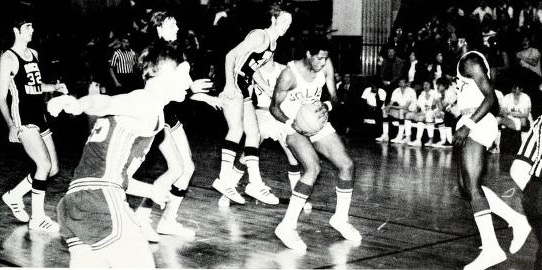

Leaper Eugene Sims over everyone. 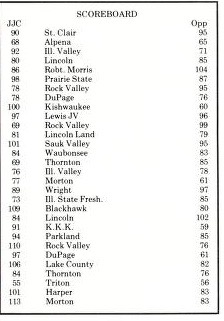

 Braidwood Beginnings
Happy to see you beat the KKK that year. Thank God!
LikeLike
Hi Tom,
Another great read!
I have two edits . Both on the first page, paragraphs 9 and 10. They are highlighted in red below.
Nice article in the Braidwood Journal about your blogs. George has a friend in their new reporter. He’s providing information and she prints it. BAHS has been in the Journal often since she began as our reporter about 8-10 months ago. Yea!
Cheers!
Dee ;
LikeLike
Thanks, Dee. You are the best! I corrected the mistakes.
LikeLike