“You might have put it a little differently, son, but I get your drift.”
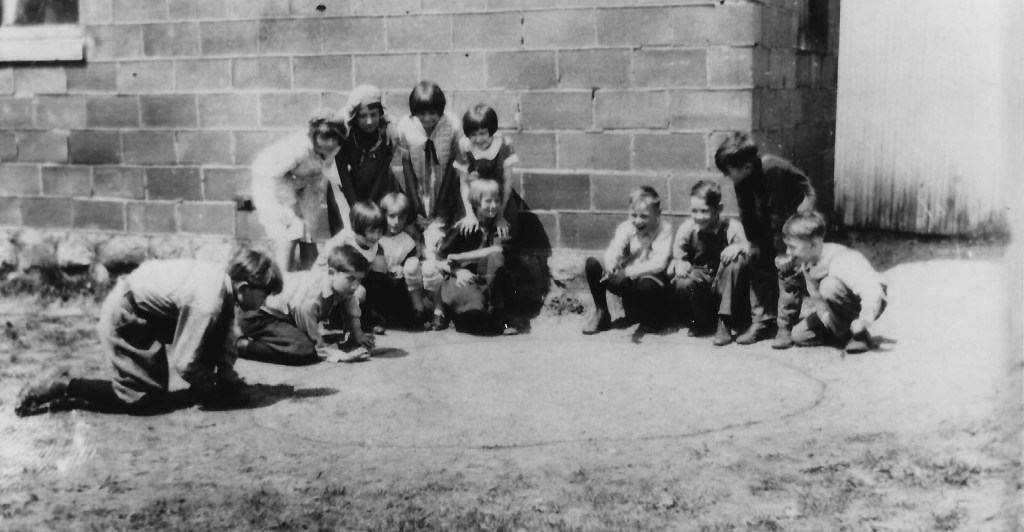
It’s a good analogy because I played “mibs” when I was in St. Rose grade school. My bag included about 20 or so glass marbles that included a “boulder, a steelie, shooter, a puree” plus others. Every day I hoped to keep my marbles and add a few. Nowadays, I play a different game and hope to maintain my current level of marbles.
Which brings me to the point about writing.
Children usually have only superficial knowledge of their parents’ earlier years including work history. Our stories have been told in a scattered mode over a number of years. Oral tradition was particularly effective in societies vastly different than ours, but even in ancient times basic documents were written, and records were kept.
For the sake of the next generation and those following, it would be helpful to pass on a “life will” that has our stories in writing and pictures. Everybody has a story, and every story may be important and meaningful to our descendants. Stories add multiple dimensions to an otherwise nondescript name in the census tally.
Why do I think that everybody has a story? Just ask a complete stranger in an airplane (if they are willing) a few questions. Some may bore you to tears, some will keep their earbuds on (don’t ask them). But for those who are open to talk about themselves, there are some fascinating tales. Everyone has a story they want to tell.
Likewise, I wish that I could better remember my two grandfathers better. We shared our time on earth only so briefly, leaving only vague, blurred memories, few pictures, and no documents. Even a few handwritten notes might have served as fragments like the ancient Egyptians left behind in their drawings and hieroglyphics on papyrus scrolls.
I have written in the past about my dad’s final days before he died. On the evening before an operation that would deprive him of his ability to speak, he seemed anxious to tell me about his days as a young man working on ranches and farms in the Dakotas. I had never heard much about this time in his life, but I was exhausted that night and eager to get home to my family. I missed my one last chance to learn more about my father and there will never be a way to get that chapter of his life. https://braidwoodguy.com/2019/12/31/life-a-dash-between-dates/
There is also comfort for us, the autobiographers, knowing that our lives will be remembered. We all have a basic desire to leave a mark, a piece of ourselves that triggers a memory in someone years after we are gone. Abraham Lincoln summarized that desire in a quote from the book, “Leadership in Turbulent Times” by Doris Kearns Goodwin. In Lincoln’s early years, “…he was more than willing to die, but he had ‘…done nothing to make any human being remember that he had lived.’” Obviously, he later had done much in which to remember him.
Our children, grandchildren, great grandchildren, nieces, and nephews will treasure the documents and pictures that you “will” forward. Pictures bring meaning to words and words enhance the pictures. They represent your legacy, your mark in their world that carries your persona. Your life will have been etched on parchment or in cyberspace, not easily buffed away especially if stored electronically.
While we enjoy reasonably good health and have sufficient enough gray matter (or marbles), it might be worthwhile to document some our own history and memories. There is satisfaction in planting some seeds of wisdom, history, and knowledge in the form of pictures, stories, and facts about our families and friends. There will be a day in the future when memory downloads into computers will enable this to happen, but in the meantime consider:
- Rummaging through old pictures and make notations on the back with names and dates. File the good ones and scan when possible.
- Keeping a journal. It doesn’t matter what you write about, but it might trigger some thoughts and memories. Future generations will value this. And don’t worry about penmanship, complete sentences, and word choices.
- Starting with a chronology of my life events such as jobs, different homes, and big events.
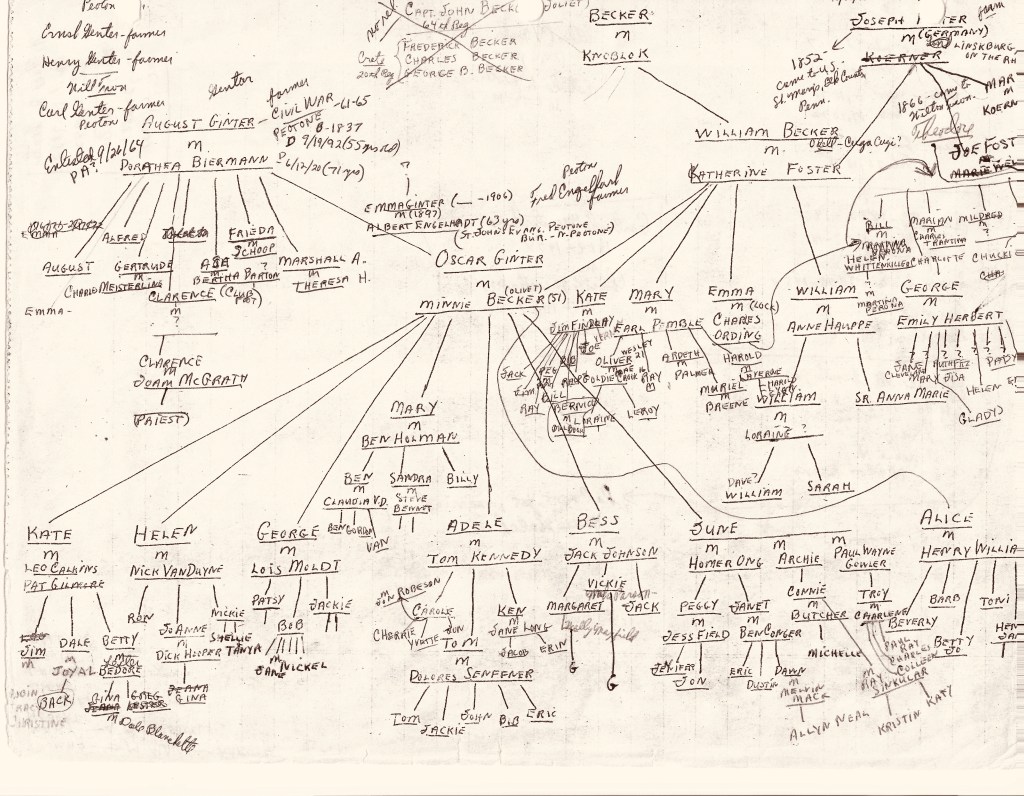
- Sketching out the family tree without lots of details. My first charts had lines drawn all of the place, but it was a start. (See picture below.)
- Filtering through old documents, magazines, etc. that your parents left to you.
- Reading books about the periods in history when your ancestors lived. It makes it much more relevant this way and gives you an idea what they had to endure. Play the music of their era also; it gets you into the mood.
- Talking with older people about their memories. I rue the days that I wasted not asking mom or dad about their early years. Include other older folks, including your relatives. People your age with interests and histories far different than yours, but they may have known your relatives.
For example. I was given a significant boost years ago when I contacted Fr. Michael Ginter to see if he could help me with the genealogy of the Ginters. He in turn recommended me to his father who provided me with records going back to 1700. I was able to contact other members of the Ginter family who helped fill in many blanks.
In marble terminology, it might be a ripe time to “knuckle down” and start getting organized for your “life will” project…for your descendants’ sake before you lose your “mibs.”

 Braidwood Beginnings
Been reading for 2 hours. (a slow reader). Great stories
LikeLike