Dear kids:
The last two letters about racism during my college days were focused on events off the basketball court and away from the Lewis campus. I am reasonably sure that racial bias was at Lewis, but it never was obvious to me.
I haven’t said much about racial discrimination in sports because my roommate, Bob Thayer, and I never experienced it. Certainly, in my brief time playing park league basketball there were numerous occasions where Black and White players might have gotten into it, but a respect and regard for athletic competition prevailed. On the college level, that same respect superseded any racial differences.
If you could score, rebound, or play defense, that was all that mattered. Until I saw it in the NBA.
Life on Campus
In many ways, you kids may be able to identify with my life on a college campus. It was my first time to live away from home for an extended period of time which meant that I had a new sense of freedom. A certain number of hours would be spent in a classroom, practice, or study in the dorm, but I also had available discretionary time.
Living in a dorm meant that one is rarely alone. Socializing with teammates or fellow students can saturate everything else in life, and there were times that I just wanted to get away by myself or with a friend. The Lewis campus was a 5-minute car ride into Joliet or Lockport. Nothing was within walking distance.
When alone, I would sometimes go into Joliet restaurants or bars (Pastore’s or Skedel’s) just to get away from the campus. On two different occasions, Bob joined me to get a sandwich and a glass of beer, but we were turned away because I “was underage.” I was later told that I should never come back with him (obviously because he was Black) and, if served, they would smash the glass that he drank from. Joliet in 1960.
Not to be deterred, Bob and I found a place where we could enjoy an adult beverage and some food. Our new place, “McGill’s Lounge,” was on Patterson Road on the southside of Joliet. The proprietor, Dick McGill, sat at the end of the bar with his dog at his side while Black and White patrons chatted and imbibed. We visited, chatted with other folks, and then drove back to the campus. This was the way it should be.
Although we were friends, teammates, and roommates, Bob and I never really talked about racism until after college. We just understood one another silently and stoically observed the obvious.
There was even one occasion when we communicated without talking. On the road with the team, he and I were again roommates and thirsting for beer. Aware of the hotel area and being underage, I volunteered to go to the liquor store but would need his 21-year old ID. Bob gave me his wallet. (No pictures on driver’s license at that time.) I took it, but he quickly asked for it back. “Just take the ID out of the wallet. There are pictures of my family in the wallet.” I took the ID and returned with some beer.
After graduation that summer of 1962, Dolores and I were married, and we were getting settled in our apartment. She was working at GMAC and I had a part-time summer job coaching at the Boys’ Club in Joliet. In the fall, I would be teaching and coaching at the new Roncalli High School in Aurora, Illinois.
That plan would be reconsidered after I got a phone call from general manager Frank Lane of the Chicago NBA team, the Packers (soon to become the Zephyrs). My chances of making the roster would be slim, but I decided to give it a chance with the assurance from Roncalli that if/when I did get cut, my teaching job would still be available.
After summer workouts and the one-week training camp in Wisconsin, I was on my way back to Chicago with two other guys who were released. One was Frank Burks who was told that he was cut because the team already had the quota of Black players.
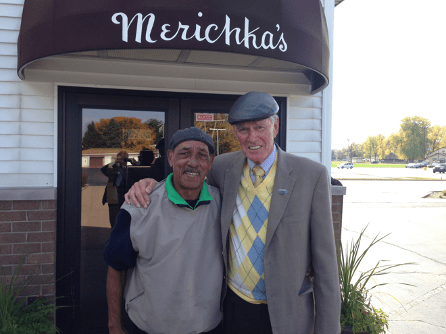
We both graduated (Bob in 1961, Tom in 1962), and we became teachers and coaches. By 1969, the country had already had 3 assassinations, race riots, war protests, and violence in Chicago. On two occasions, Bob, Gordie Kendall, Pat Sullivan, and I met at our house to finally discuss race, discrimination, and segregation until the late hours. Where was all this headed going into the 1970s? Now in 2020, we have the same questions.
Kids, I hope that this letter gives you some idea how things were in the 1960s and that you will try to see the world through the lens of others who are different from you. This can be accomplished only through knowing people who aren’t like you. Relationships and friendships with a diverse population is the solution to understanding one another. Listen and learn from one another.
Sincerely, your grandfather.

 Braidwood Beginnings
Great blog, Tom ! Sport was a vehicle that most of the time transcend race. It was not what color someone was, but could he play. In the playground we often played “winner stays,” so you wanted good players on your team, regardless of color.
We both made life-long friends on those playgrounds and learned to respect everyone with respect and dignity. Sport was a good teacher !
LikeLike