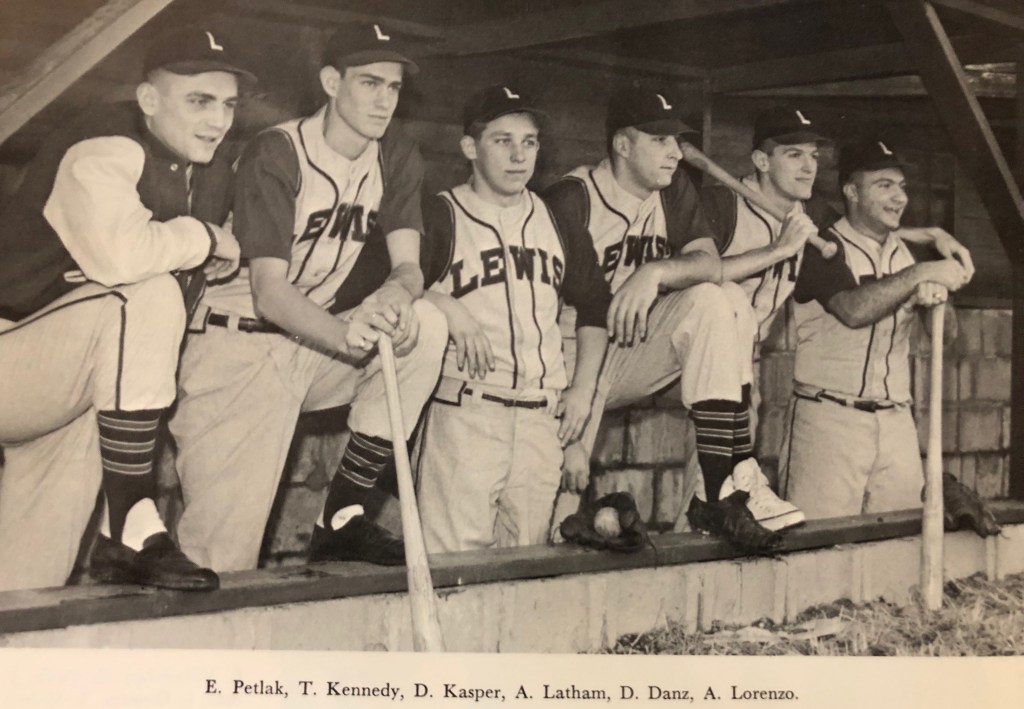
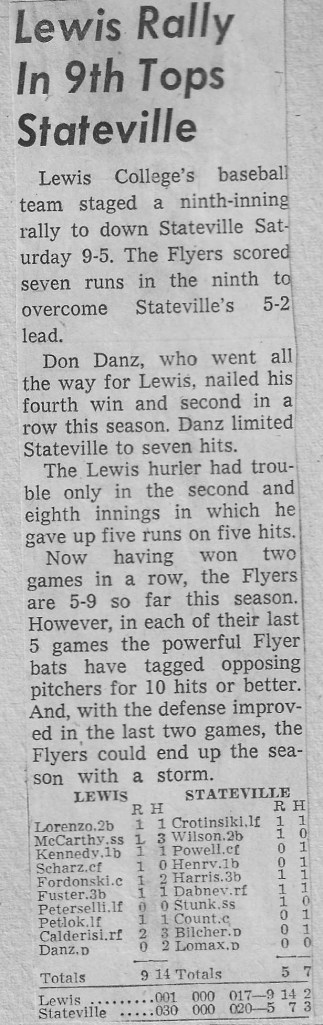
“As I stepped into the batter’s box, I realized that I was facing pitcher ‘Shotgun’ Bilcher, a convicted killer. At age 19, I just wanted to get a hit and ‘Shotgun’ was just another ballplayer. Right.“
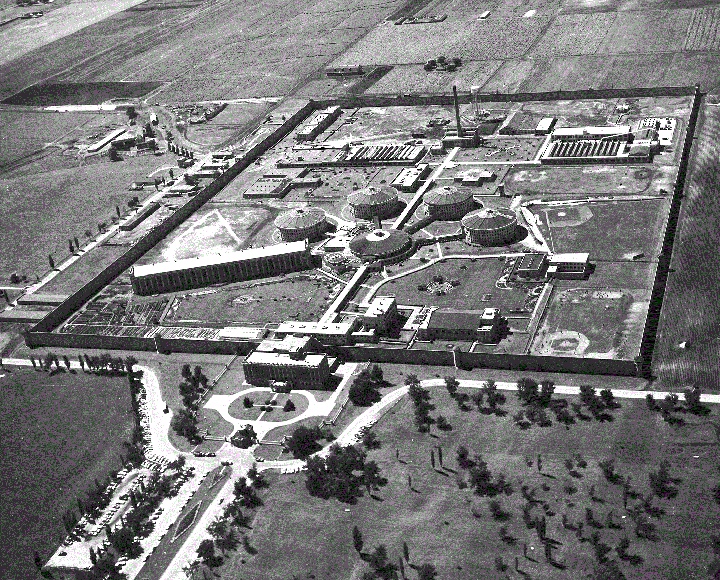
Every year Lewis College and my semi-pro team, Nielsen Gas Station, scheduled baseball games at the two Joliet penal institutions. Stateville and the Collins Street Prison had well-manicured fields and were gracious hosts to visiting teams. You could count on the games to be competitive, sportsmanlike, and entertaining. Plus, it was a chance for us to see inside the high walls while most people only saw the exterior.
The routine at each facility was the same: go through the entrance, be searched, have a tour of the facility, have huge lunch, and then proceed to the field to play the game. The umpires were prisoners which, at first glance, would seem to be a conflict. But could you imagine having the guards be the umpires? “Kill the ump” could have a literal meaning.
The fans in the stands were fellow prisoners under the watchful eyes of the guards near the stands and in the towers above. My first thought was that the umpires would be partial, or “homers,” and the fans would be only cheering for their “classmates” and against the visitors. At least, that had been my high school and college experience where the home team would uniformly cheer against us and the umpires were unknown. That clearly wasn’t the case in the prison setting because of the gambling (usually for cigarettes) that was taking place in the stands. In any case, the fans were equally divided.
The prison band started with the national anthem before the game but strangely continued playing songs throughout the first three innings even with pitchers and batters being active. After the second inning, we became accustomed to what had been a distraction, but I couldn’t help thinking what would have happened to organist Nancy Faust if she had done the same at a Sox game.
Water fountains were accessible between the stands and the dugouts with fans and players using them. For a maximum-security institution, this arrangement still puzzles me but there were no problems.
Pat Sullivan’s Stateville Memories
- In one game, Ed Spiezio and I hit home runs over the wall. As I was rounding the bases, I heard a number of inmates yelling, “I’ll go get it!” It was my only homer in my college career while Ed broke home run records.
- They feed you a lot right before the game. A teammate, Bob H., had played there many years and was well known by the prisoners. He was on 2nd base, when the hitter hit a double, and Bob slid into home… and then threw up his lunch. The prisoners cheered!
- Cigarettes – During the tour of the prison before the game, a number of inmates would ask who was pitching because they were betting cigarettes on the game.
- The prison players got off work to practice so the fans often disliked the fact that they were getting out of work. Often the majority of the fans, especially those not betting, cheered for the visitors.
- Usually, guys were in prison because they stole something. I had a friend, John M., who stole FROM the prison – a very nice pitching jacket.
An Ugly Truth
On that particular spring day in 1959 on my first time inside those walls, I was struck by the notion that the majority of the inmates seemed to be African American. Even at that early age, I was aware that the U.S. population was about 90% white. Why wouldn’t the inmate population of 2,400 roughly reflect the national statistics?
I would spend the next 60 years seeking answers to that question. I found that the root causes for were complex and unanswerable without recognizing ugly historical truths that even today defy simple responses and solutions. The nation’s soul continues to be severely tarnished.
During and after the game, we all had the chance to talk with inmates and found them all reasonably intelligent, regular people. What happened to them to be in this place? Never did find that out as it was too personal and intrusive. After that first game at Stateville, I would have several more chances to play ball inside the walls.
“Shotgun” Bilcher? I never found out any more about him and whether he was released, but after that first pitch, he was just another ball player to me. Not a monster, but a fellow human being.

 Braidwood Beginnings
That was an interesting, picture of a view behind the prison walls.
LikeLike
What was the penalty for stealing a base?
Also , did you have any of the players baseball cards with you when you and Rich Binder met to discuss your collection back in the mid ’70’s?
LikeLike
As a matter of fact, I did, Bob. Had some in my desk drawer. When I took them out, Rich and I bonded. He is a great guy.
LikeLike