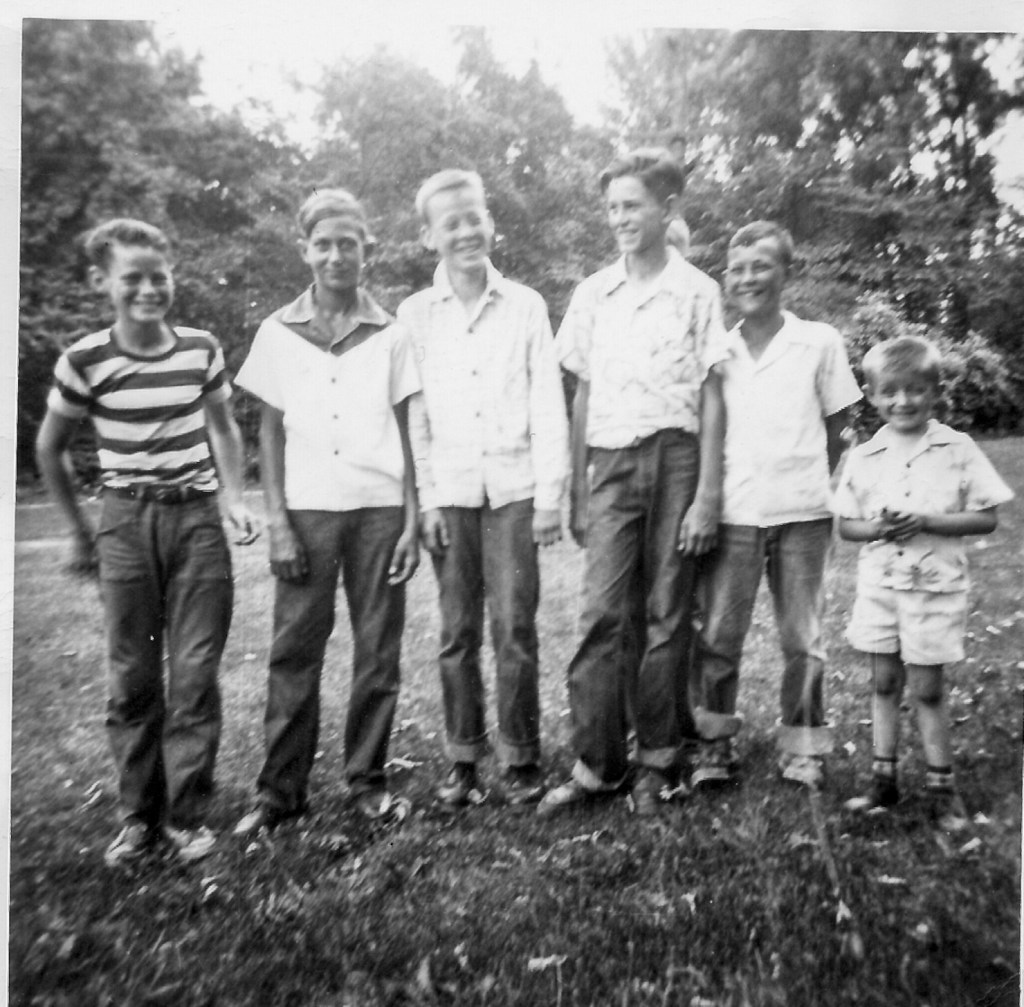
“Saturday morning was come, and all the summer world was bright and fresh, and brimming with life. There was a song in every heart; and if the heart was young, the music issued at the lips. There was cheer in every face and a spring in every step. The locust-trees were in bloom, and the fragrance of the blossoms filled the air.”
Mark Twain, The Adventures of Tom Sawyer
We had it all. Everything a kid could want. Fossils, fool’s gold, lakes, trees, hills, and a baseball field. That was Braidwood for a ten-year period in my life, between 1949 through1959. In some ways, it would be the best ten years of my life.
Neighboring Wilmington
Nearby, Wilmington had the beautiful but temperamental Kankakee River, whose depths would change between the seasons. Whose restless waters would slow and freeze, choking and coughing across the island and flooding local businesses.
Beautiful and sullen, the river mirrored history. The likes of Marquette and Joliet paddled down those waters long ago. Years later and only a few miles away, the discovery of coal would uproot trees and prairie.
Death of a Prairie, Birth of Recreation
Coal mining companies had little regard for the welfare of the men and boys – they who would work and die in the mines – and for the land’s defacement. Collateral damage must be sacrificed for corporate profits. Laborers could be replaced. And the land? Who cares?
But the hardy survivors and their descendants withstood those harsh times and gradually grasped the dormant quality of the scarred ground. Initially, three residents (Fred Nahas, Anton Ruva, and MJ Donna) envisioned a plan in 1949 to transform the earth into a vast recreation area.
One of those visionaries, MJ Donna, spearheaded the project that would partner the people and the land (with collaboration of nature’s creatures). That partnership would transform the water-filled cavities into lakes, and the barren mounds – despite perpetual resistance from its composition of clay and rocks – into vegetation covered hills.
My Braidwood Playgrounds
Before moving to Braidwood’s East Side, I had the good fortune to be raised only a few feet from the town’s baseball field, just behind the high school. What future baseball player and coach wouldn’t give for that luxury?
Once we relocated to the East Side, the newly established Recreation Club was within 400 feet of our house on East Main Street. The BRC was comprised of a swimming area, numerous fishing lakes, and countless hills to climb. Within 30 minutes, my sister and our friends could transport ourselves outside of civilization and incommunicado with parents.
Armed with hatchets and knives, our tasks might include building huts, searching for fool’s gold (pyrite), fossils, and scouting previously untraveled hills and lakes. At the time, there were few roads through most of the strip-mined area.
To the south of our house was the “Q” hill, a product of an old shaft mine. Accessed by a walk through a farm field, the “Q” was ideal for sledding in the winter time. It was also in an area that the “honey dippers” disposed human waste collected from septic tanks and outdoor toilets. (For some reason, the best blackberries could be found near here in late summer.)
A Time with Few Responsibilities
Unlike the time that followed, those ten Braidwood years produced memories that could never be replicated. Of course, newspapers had to be delivered in late afternoon, trumpet lessons needed to be practiced, errands had to be tended to, and homework to be finished.
But these were simply diversions to be be tolerated and easily deferred or dismissed. The main goal was to float without regret through the best ten years of a boy’s life.
“So endeth this chronicle. It being strictly a history of a boy, it must stop here; the story could not go much further without becoming the history of a man.”
Mark Twain, The Adventures of Tom Sawyer

 Braidwood Beginnings
When I was ten in Braidwood, I thought those strip mine hills were really mountains.
LikeLike
Well, Karen, they were mountains to me, too. By the way, can you tell me how many Black families lived in Braidwood when we were growing up? I can think of your family, the Pinnicks, Turners, Dillards, and the Ericksons. Any others? Is Sandra Pinnick still alive?
LikeLike
I thought there were 10 Black families. Add the Carters, Williams and the Wells to your list, that makes eight we can think of now. There was the MacFarland’s but they had moved by the time I was growing up. If you add them makes nine
Sandra Pinnick, my first cousin. The first Black person to join the Catholic Church there, passed some time ago in Boston. There was a service at Patterson’s.
LikeLike
I watched John Mac play baseball when I was young and then had the privilege to play on a Joliet team with him. I am sorry about Sandra. She was a friend of my sister’s. Thanks for adding the names for me. I will be writing about them. Tim Pinnick has done research of the Black families in Braidwood. I will also ask him.
LikeLiked by 1 person
I just talked with the brother (who still lives in Braidwood) and my sister who lives in Oregon, Illinois. My brother said that there was a young black kid named Ruby Topps. He would have graduated from high school in 1967. My sister remembers an old black guy who lived along Rt. 113 between our house, (near Patterson’s) and Essex Rd. Mom would give him meals sometimes when he walked from town and she also gave him a coat during the winter. Do you remember any of this? Also, Susie Erickson’s husband John? Maybe an old gentleman lived with them?
LikeLike
No Susie and Johnny Erickson lived in the G dump area, 3 blocks west of School Street. But we are up to 11 Black families now, if you received my reply about the Tops family. Maybe 12 is you include one arm Frank, that possibly your sister fed that rode a bicycle and had one arm.
LikeLike
Wow, Karen. This fills in a lot of blanks for me. Than you so much.
LikeLike
I have two pictures that I hope you can identify. I sent them to your email address.
LikeLike
Those were fun years. Remember the quick sand sat the Q? Our dog, Tippy, got caught in it and somehow you got her out. I was impressed by my big brother at how smart he was. I also remember floating out in one of the pits in a discarded car hood feeling wild and free. Lucky we are still alive! Did Mom know what we were up to?
LikeLiked by 1 person
Did mom know? Probably not. You floated in a car hood? I am impressed.
LikeLike
Tom:
That boy’s history is so wonderful to read. I didn’t want it to stop,
after those 10 years! Thanks for including the names of the men whose
visions of a recreation area became a reality for so many to enjoy,
close to “home”.
Thank you for using your talent to share these stories!!!
Cheers!
Dee
LikeLike
Thanks, Dee. It’s easy to write about things so dear to us. I would love to have you write your story.
LikeLike
What a great adventure to live so close to,
LikeLike
The 10th Black Family is the Tops Family. The moved to Braidwood when I was in Fifth grade. Ruby Tops was in my class. He had two older sisters and a younger sister. They lived off the frontage road near the old Braidwood motel. The old guy could have been a guy that my Dad referred to as one arm Frank, if he road a bicycle? We used to see a guy riding a bike to Joliet all the time and my Dad would refer to him as old one arm Frank. I think his name was Frank Laska.
LikeLike
Thanks, Karen.
LikeLike