
Karen and I were both raised in Braidwood but didn’t know each other. Although she is 8 years younger than me, we walked and rode our bikes down the same streets, shopped in the same stores, and knew most of the same families in town. I even delivered the Joliet Herald-News to her house and collected money for that paper once every two weeks from her mom and dad. Karen left Braidwood when she got married in 1976. I did the same when Dolores and I got married in 1962.
Two Kids: One Black, One White
For her first years of life, she and I lived only a few blocks from one another. My house was on Walker Street, her house was on School Street. Then, when I was 13, my family moved to the East side of town where we bought our first house. Karen’s parents had owned their own house for decades.
Although she and I were “neighbors,” the eight-year difference prevented us from getting to know one another. But the common bond that Karen and I have is that we were both raised in that small coal town of Braidwood.
But there were differences. We attended different church services and attended different grade and high schools. After my first and second grades at the East Side School, I continued my early education the next 10 years in Wilmington and Joliet while Karen went to the public school in Braidwood all 12 years. I spent much of my teen-age summers swimming and hiking at the Braidwood Recreation Club. Karen and her family weren’t allowed to go there.
I asked Karen Anderson Baker, whom I have known as a friend over the past five years, a few questions about her Braidwood experience and about her family. I thought that it might be interesting to compare and contrast how our experiences might be similar or different.
Braidwood History That Few Residents May Know
Karen’s grandfather Anderson came to Braidwood during the 1877 miners’ strike. He contracted “black lung” disease and died at an early age leaving Karen’s dad, Ed, and his siblings as orphans. These children were then raised by an aunt in Joliet but the homestead in Braidwood continued as the Anderson house.
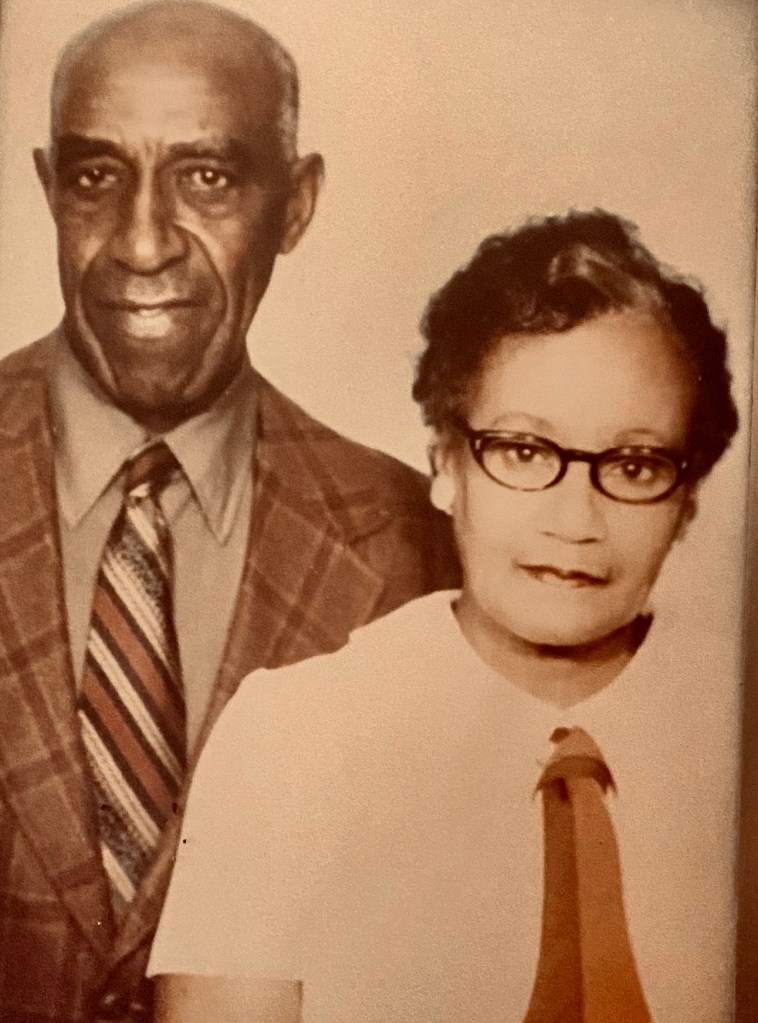
Ed worked from the age of ten, helping support his Joliet brothers by working as a tailor and owning an automobile garage repair shop in Chicago (under an Italian name). While he was in Joliet, he met Olivette Williams, daughter of a Louisiana Baptist pastor. The two 19-year-olds married, moved to Chicago for a while before relocating back to Ed’s birthplace, Braidwood. Ed had continued paying his taxes on the original Anderson home during all those years and maintained his ownership. Later, he would buy up more property around Braidwood and farm part of it.
From the day he was born until the day that he died, Karen’s dad loved living in Braidwood.
The same couldn’t be said of Karen’s mother. According to Karen, “She hated it. She might not have hated it if she had been able to drive a car. But dad was ‘old school’ and not a fan of her driving.”
About Karen
“I grew up like an only child, introverted and quite shy. There are 17 years difference between me and my oldest sibling. My sister was living in Chicago and my Braidwood brother was drafted during the Korean War. After the war, he returned to live with my grandmother in Chicago. My grandfather had become the pastor at the Greater St. John Baptist Church in Chicago.”
As an African American, Karen’s early years in Braidwood were not positive at the time she was growing up. Looking back on those years, Karen now reflects on that time a little differently.
“It was positive as I see life today. I was one of two African Americans in kindergarten. I would always get picked last, or not at all, during games. After school my parents would pick me up in their station wagon. Two boys would always make fun of me. But when we were in high school, they were nice to me. By second grade, the other kids started involving me in games.”
In her neighborhood, Karen was subjected to racial slurs by older kids as well as some adults.
“When I rode my bike to get a few things for mom at Emma Kucha’s store, some older boys whose father was an alcoholic would yell racial slurs at me. But those same boys became quite nice to me when I got older. Later, even the father of one of my friends would use racial slurs at me. It was hard to ignore this.”
How many African American kids were in your classes?
“There were six in my grade school and six in high school. Most of the Black families had migrated to Joliet for better job opportunities.”
Social life in Braidwood for an African American?
“I did not date due to the slim dating pool, so I thought at the time. I started dating when I was car pooling to Joliet Junior College with some of my white classmates. It was rather difficult when I ate in the cafeteria with my friends from Braidwood. The Joliet Black students did not understand the dynamics of that.”
When did you leave Braidwood? Ever think of moving back?
“I left Braidwood when I married at age 26. I was the last of the Anderson kids to leave. My husband was always considerate of my parents and helped them on weekends until they both passed. My father wanted me to investigate some land in Braidwood and build a house there, but I kind of had enough. He loved it there.“
Concluding Comments
Readers of my Braidwood blogs are well aware of my experiences about growing up in my hometown. I can’t think of many negative stories. Karen, a young Black girl, dealt with racial slurs and feeling isolated until her later grade school years. She was confronted by hatred – for no reason except skin color – by young boys and older men.
Karen was probably protected by her parents from some of the harsher racial realities that might have been evidenced by discrimination against travelling Black people at the nearby local restaurants and truck stops on Route 66. I have heard about racial incidents occurring locally during the 1950s and 1960s. (Other local area towns had official or unofficial “sundown” laws.)
“I remember when Goose Tatum, a Harlem Globetrotter, passed through Braidwood on old Rt 66 and wanted to stay at Rossi Motel for the night. They denied him but then called up my Dad and asked him if he would ‘sponsor him,’ so to speak). I was about 12 when that happened. I was in a state of confusion about the matter.”
She also may have been shielded from more serious episodes due to the fact that her mom and dad were highly respected by almost all white Braidwood citizens. Ed’s family, along with the Pinnicks, were probably more “native” than most of the other residents.
Beside the Anderson family, there were at least 10 other African American families in Braidwood during Karen’s time there: Pinnicks, Turners, Tops, Dillards, McFarland, Carter, Erickson, Williams, and Wells. (Plus, a man called “One-arm Frank.”)
Currently (2023), I am not aware of any African Americans who live in Braidwood. And most residents aren’t aware that Black people played a major role in the history of our town.
My kids, grandkids, and other readers will benefit by hearing a Braidwood story from a person who has a different perspective than mine. Braidwood in the 1940s and 1950s had more diversity than any of the surrounding towns, but it was not Utopia. Black people’s stories seldom get told from those who lived it, and white people seldom want to hear those stories. Thanks, Karen, for the privilege of telling part of your story.
Article from Jet Magazine 1962


 Braidwood Beginnings
We all need to hear these stories, our grandkids need to hear these stories. I grew up so naive not knowing what our friends , Sandra and Buddy were Experiencing. Talk about “white privilege”, I didn’t have a clue. Let’s educate our kids about our history and hopefully the next generation will make a difference in racial injustice. (And vote)
LikeLike
It’s awful to say but, my parents really believed they were better than African Americans. So glad I didn’t follow their believes.
LikeLike
Judy, our parents (mine, too) were products of their time. Each generation has its own deficiencies and misinformation. My hope is that each succeeding generation will get better and better while continuing the more positive parts. Thanks for the comment, Judy.
LikeLike
My grandma and Grandpa Bohac lived next to the Andersons for a short time. Karen and my sister Ellie were good friends I can remember them sharing a Tootsie pop one day. LOL I didn’t really know Karen’s mom but everybody had great respect for Ed Anderson.
LikeLike
Thanks for sharing about Ellie. I do remember her as being a really nice person. Karen
LikeLike
I truly enjoyed reading this story. I’ve known Karen for a long time. She is a good friend of my family . To know her is to love her ❤️
LikeLike
Thanks, Barbara. There are many other stories that I have written that you might enjoy. Check them out.
Yes, Karen is a special person. Her dad was a favorite of mine when I was growing up in Braidwood. Mud Pinnick was another admirable gentleman. I played baseball with Danny Turner and my son, Tom, played basketball at Providence with his son, Danny. We have a lot of common connections, don’t we?
Tom K
LikeLike
Thanks, Barbara. I don’t know Karen as well as you do, but she is the real deal.
Tom K
LikeLike